

If you’re selling into restaurant chains, you’ve likely seen this happen.
They open emails.
They explore your website.
They download content.
Sometimes they even take a call.
Everything points to interest.
But when it comes to conversion?
Nothing moves.
Deals stall. Conversations fade. Pipeline slows down.
It feels like you were close.
But the reality is different.
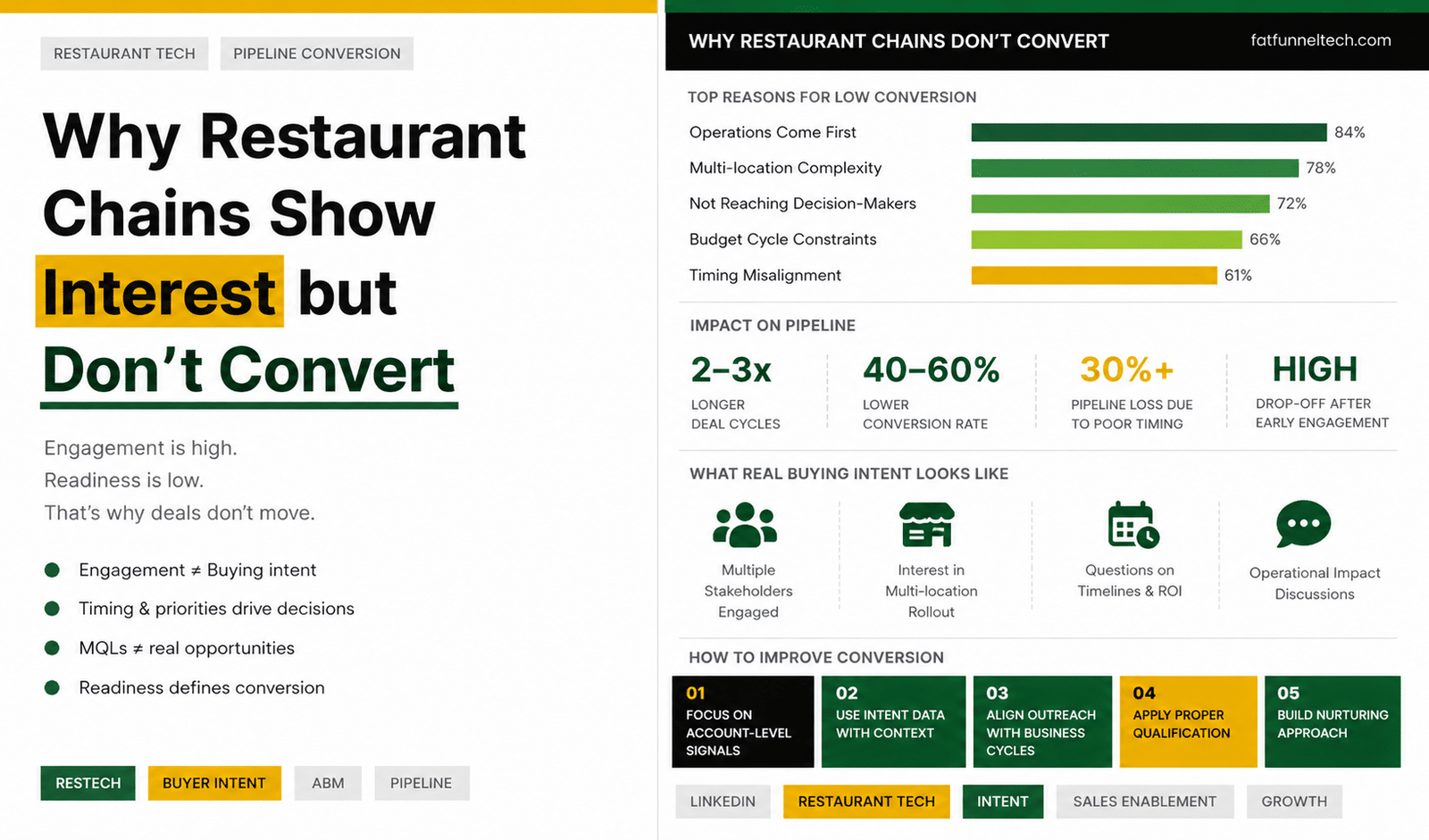
Restaurant chains don’t struggle with interest. They struggle with timing, alignment and priorities.
Engagement Looks Strong. Intent Is Not
Restaurant chains are constantly evaluating tools.
They look at:
- POS systems
- Ordering platforms
- Analytics tools
- Customer experience solutions
But evaluation is ongoing.
They are always exploring better ways to operate.
That doesn’t mean they are ready to buy.
So while engagement is high, intent is often low.
Why Restaurant Chains Don’t Convert
1. Operations always come first
Restaurants are operationally intense.
Daily priorities include:
- Managing staff
- Handling supply chains
- Maintaining service quality
Technology decisions take a back seat.
Even if your solution is valuable, it may not be urgent.
2. Multi-location complexity slows decisions
For chains, decisions are not simple.
They need to consider:
- Standardization across locations
- Integration with existing systems
- Impact on staff and workflows
A solution that works for one outlet must work for all.
That level of evaluation takes time.
3. You’re not reaching the final decision-maker
Many campaigns engage:
- Store managers
- Operations teams
- Mid-level executives
But final decisions are made by:
- Founders
- Directors
- Senior leadership
Without reaching them, deals don’t move forward.
4. Budget is planned, not flexible
Restaurant chains often work with fixed budgets.
Tech investments are tied to:
- Expansion plans
- Renovations
- Seasonal cycles
Even if interest exists, if your solution is not part of the current budget cycle, it gets delayed.
5. Timing is everything
A chain might engage with your solution today.
But real buying happens when:
- They expand to new locations
- They face operational inefficiencies
- They decide to upgrade systems
If your outreach is not aligned with these moments, conversion drops.
The MQL Problem in Restaurant Tech
Most ResTech campaigns generate MQLs based on:
- Email engagement
- Content downloads
- Website visits
But these signals reflect curiosity.
Not commitment.
So sales receives leads that look promising.
But are not ready.
And conversion suffers.
What Real Buying Intent Looks Like
In restaurant chains, true intent shows up differently.
You’ll often see:
- Multiple stakeholders involved in discussions
- Interest in implementation across locations
- Questions about rollout timelines
- Conversations around ROI and operational impact
These signals are less frequent.
But far more reliable.
Where Most Campaigns Go Wrong
1. Treating all engagement as equal
Not every click means interest.
Not every download means intent.
Without deeper qualification, your funnel fills with noise.
2. Engaging too aggressively
When sales reaches out too early:
- Buyers feel pressured
- Conversations lose relevance
- Engagement drops
Timing matters more than speed.
3. Lack of sales and marketing alignment
Marketing sees activity.
Sales expects readiness.
Without a shared understanding of intent, leads get mishandled.
How to Improve Conversion with Restaurant Chains
1. Focus on account-level signals
Restaurant decisions are not made by individuals.
Look for:
- Multiple stakeholders engaging
- Consistent activity across the account
This indicates stronger intent.
2. Use intent data with context
Intent data helps identify:
- When chains start exploring solutions
- When interest increases
But it needs interpretation.
Not every signal means immediate opportunity.
3. Align outreach with business cycles
Timing outreach around:
- Expansion plans
- Seasonal changes
- Operational challenges
improves relevance and response.
4. Apply proper qualification
Frameworks like BANT help when used correctly.
Focus on:
- Who makes the decision
- Whether there is an active need
- When the purchase is expected
Without this, leads stay unqualified.
5. Build a nurturing approach
Not every engaged chain is ready to buy.
Stay relevant by:
- Sharing insights
- Providing value
- Maintaining consistent communication
So when the timing is right, you’re already in the conversation.
The Real Issue
Restaurant chains don’t convert because they are not interested.
They don’t convert because they are not ready.
When teams confuse engagement with intent, they push too early.
And lose deals that could have closed later.
Final Thought
In restaurant tech, engagement is easy to generate.
Conversion is harder.
The difference lies in understanding:
- Timing
- Decision-making complexity
- Real intent signals
The goal is not to chase every engaged account.
It’s to identify which ones are moving toward a decision.
Because in the end, deals don’t come from activity.
They come from readiness.
Leave a Reply