

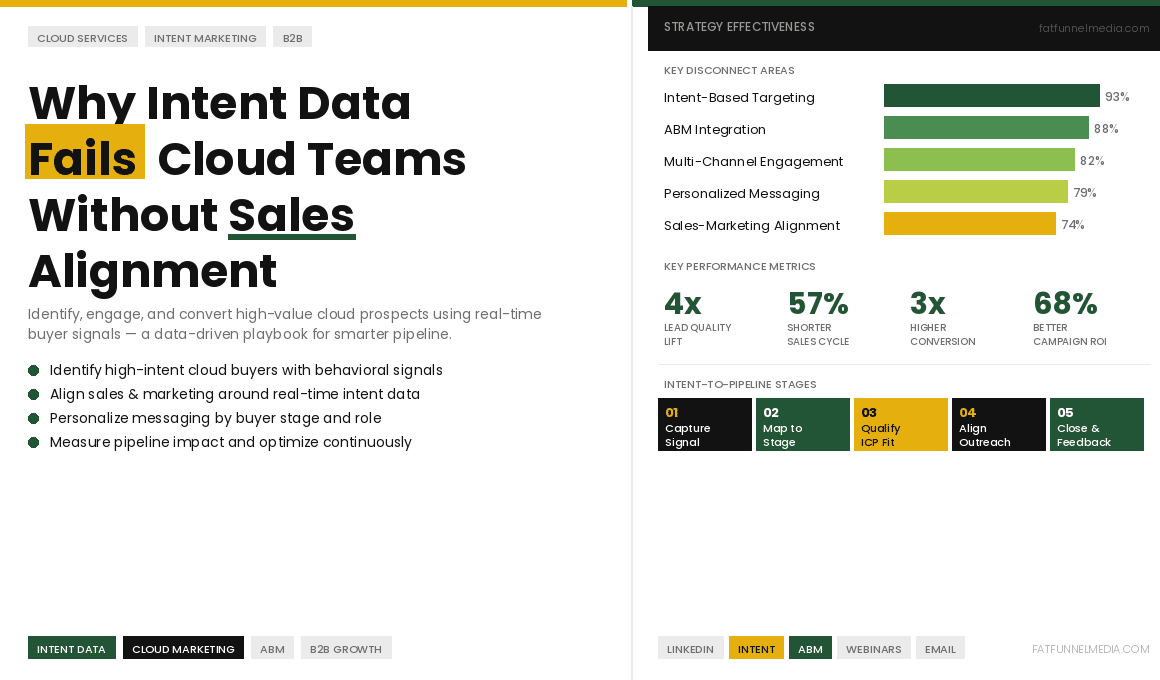
Why Intent Data Fails Cloud Teams Without Sales Alignment
Intent data has become one of the most talked about tools in B2B marketing. Especially for cloud companies where long sales cycles and complex buying groups are the norm, it promises something every team wants: visibility into who is ready to buy.
But here’s the uncomfortable reality.
Most cloud teams already have access to intent data. Yet pipeline quality remains inconsistent. Deals stall. Sales complains about lead quality. Marketing insists the leads are “high intent.”
So what’s going wrong?
It’s not the data. It’s the disconnect.
The Illusion of “High Intent” in Cloud Marketing
Intent data can show you which accounts are researching cloud migration, infrastructure optimization or security upgrades. On paper, that sounds powerful.
But intent signals don’t equal buying readiness.
A company downloading content about cloud cost optimization might be:
- Exploring options for next year
- Comparing vendors without urgency
- Or simply educating internal teams
Marketing often treats these signals as immediate opportunities. Sales walks into conversations expecting urgency. The result is friction.
Without alignment, intent data creates false confidence.
Where Cloud Teams Get It Wrong
1. Marketing optimizes for activity. Sales needs context.
Marketing sees:
- Content consumption
- Website visits
- Third-party intent spikes
Sales needs:
- Why now
- Who is driving the initiative
- What problem is urgent
Without that layer of context, intent data becomes noise.
2. No shared definition of a qualified account
One of the biggest gaps is how teams define qualification.
Marketing may push accounts based on:
- High intent scores
- Multiple engagements
Sales qualifies using:
- Budget clarity
- Decision-makers involved
- Timeline
If these definitions don’t match, MQLs never become SQLs.
And the blame game begins.
3. Intent signals are not mapped to buying stages
Not all intent is equal.
Early-stage signals:
- Blog reads
- Generic keyword searches
Late-stage signals:
- Product comparisons
- Vendor-specific research
- Integration-related queries
Most cloud teams fail to differentiate between the two.
So sales ends up chasing accounts that are not ready.
4. No feedback loop from sales to marketing
This is where things break completely.
Sales teams know:
- Which accounts are serious
- Which conversations are going nowhere
- What objections keep coming up
But this feedback rarely flows back into marketing.
So marketing keeps targeting similar accounts. The cycle repeats.
Why This Problem Is Worse in Cloud Sales
Cloud deals are not simple purchases.
They involve:
- Multiple stakeholders
- Technical validation
- Budget approvals
- Long evaluation cycles
Intent data without alignment amplifies confusion instead of reducing it.
Because in cloud, interest is easy to generate. Commitment is not.
What Sales Alignment Actually Looks Like
Fixing this is not about buying better data. It’s about using it differently.
1. Agree on what “intent” really means
Both teams need to define:
- What signals indicate curiosity
- What signals indicate buying intent
Not every spike should trigger outreach.
2. Build a shared qualification layer
Intent data should not directly create MQLs.
It should feed into a qualification framework that includes:
- ICP fit
- Buying stage
- Stakeholder involvement
This is where frameworks like BANT become useful when applied realistically.
3. Align outreach with buying stage
Instead of pushing sales conversations too early:
- Early-stage accounts → educate and nurture
- Mid-stage accounts → problem-led engagement
- Late-stage accounts → direct sales outreach
This shift alone improves conversion quality.
4. Create a closed feedback loop
Sales should actively report:
- Which intent-driven accounts converted
- Which ones stalled and why
Marketing should use this to refine:
- Targeting
- Messaging
- Scoring models
Without this loop, intent data will never improve.
The Real Role of Intent Data in Cloud GTM
Intent data is not a shortcut to pipeline.
It is a signal layer.
Its value depends on:
- How well marketing and sales interpret it
- How clearly buying stages are defined
- How consistently teams communicate
When aligned, intent data helps prioritize the right accounts.
When misaligned, it floods the funnel with noise.
Final Thought
Cloud teams don’t struggle because they lack data.
They struggle because data is used in isolation.
Intent without alignment creates activity. Not revenue.
If marketing and sales are not working from the same definition of intent, the same view of the buyer and the same qualification standards, even the best data will fail.
And when it does, it’s easy to blame the tool.
But the real issue is how teams work together.
Leave a Reply