

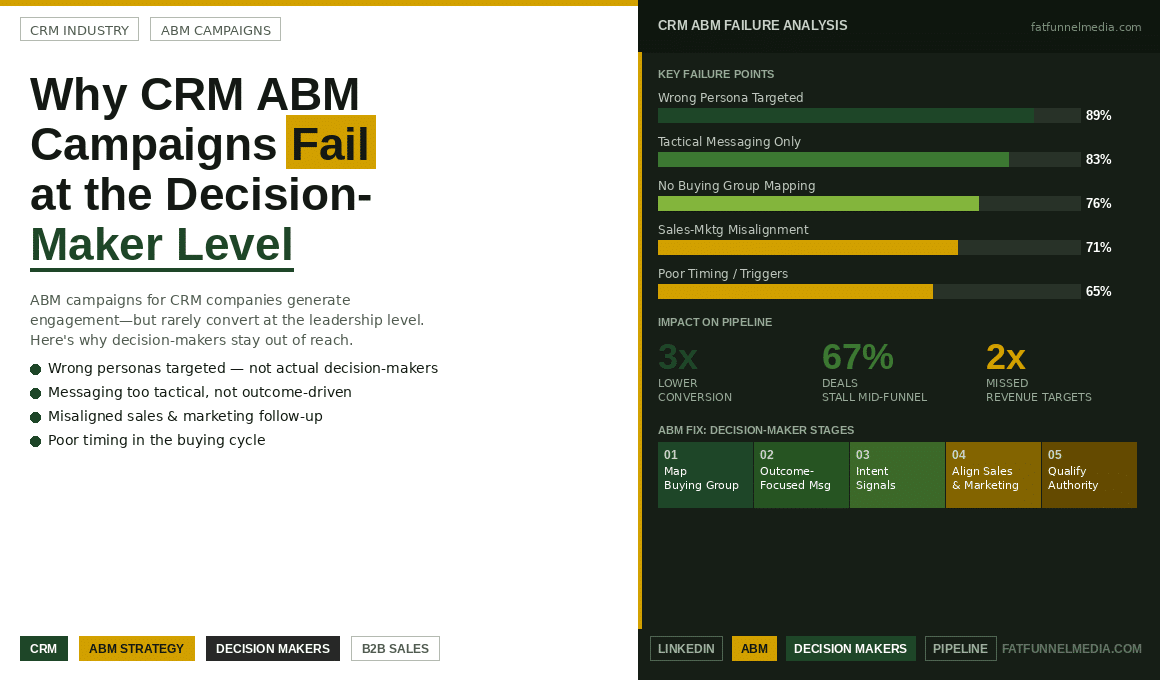
ABM sounds perfect for CRM companies.
You know your target accounts.
You personalize outreach.
You focus on high-value deals instead of volume.
On paper, everything is aligned.
But in reality?
Most CRM ABM campaigns generate engagement without conversion.
Emails get opened.
Content gets consumed.
Meetings get booked.
Yet deals don’t move forward.
The problem is not ABM.
It’s who you’re actually reaching.
Engagement Is Not Influence
In CRM campaigns, it’s easy to mistake activity for impact.
You might be engaging:
- Sales managers
- CRM admins
- RevOps analysts
These roles interact with your content. They respond to outreach.
But they rarely make the final decision.
The real decision-makers are:
- CROs
- Sales directors
- Business heads
And most ABM campaigns fail to reach them in a meaningful way.
So while your campaign shows traction, it lacks influence.
The Hidden Gap in CRM ABM
ABM promises account-level targeting.
But many campaigns still operate at a contact level.
This creates a gap.
You’re targeting the right company.
But not the right people within it.
Or worse, you’re only reaching one layer of the buying group.
CRM purchases involve multiple stakeholders:
- End users
- Technical evaluators
- Financial decision-makers
If your campaign only speaks to one group, it stalls.
Why Decision-Makers Don’t Engage
1. Your messaging is too tactical
Most CRM campaigns focus on features:
- Automation
- Reporting
- Integrations
But decision-makers care about outcomes:
- Revenue growth
- Sales productivity
- Forecast accuracy
If your message doesn’t connect to business impact, it gets ignored.
2. You rely on generic personalization
Using a company name or industry reference is not enough.
Decision-makers expect:
- Insight into their challenges
- Context about their market
- A clear point of view
Without that, ABM feels like mass marketing with a thin layer of personalization.
3. You’re not aligned with buying priorities
Just because a company uses a CRM doesn’t mean they want to change it.
Decision-makers act when:
- Current systems fail
- Teams complain about inefficiency
- Revenue goals are at risk
If your campaign doesn’t align with these triggers, it won’t convert.
4. You engage too early or too late
Timing is critical in CRM sales.
Early-stage:
- Decision-makers are not involved yet
Late-stage:
- Vendor shortlist is already defined
If your campaign misses the right window, access becomes difficult.
5. Sales and marketing are not aligned
This is where most ABM efforts break.
Marketing generates engagement.
Sales follows up without full context.
Or worse, sales reaches out too aggressively.
Decision-makers disengage.
Without coordination, ABM becomes disjointed.
The MQL Trap in CRM ABM
Even in ABM, many teams fall back on MQL thinking.
They track:
- Email clicks
- Content downloads
- Webinar attendance
But these signals often come from non-decision-makers.
So the campaign looks successful.
But pipeline doesn’t grow.
This is where ABM fails at the leadership level.
Because it optimizes for engagement, not influence.
What Reaching Decision-Makers Actually Requires
1. Shift from persona targeting to buying group targeting
Stop focusing on a single contact.
Map the entire buying group:
- Who influences
- Who evaluates
- Who decides
Your campaign should engage all layers.
2. Build messaging for business outcomes
Decision-makers don’t care about tools.
They care about:
- Revenue impact
- Cost efficiency
- Competitive advantage
Your content and outreach should reflect that.
3. Use intent data to identify real buying signals
Not all engagement is equal.
Look for signals like:
- Vendor comparisons
- CRM migration research
- Integration-related queries
These indicate active evaluation.
4. Align marketing and sales outreach
Marketing creates awareness.
Sales builds relationships.
Both need to:
- Share account insights
- Coordinate messaging
- Follow the same timing
Without this, decision-makers receive mixed signals.
5. Qualify beyond engagement
Frameworks like BANT help, but they need to be applied properly.
Focus on:
- Who owns the decision
- Whether there is urgency
- If budget conversations have started
This separates interest from intent.
The Real Role of ABM in CRM Sales
ABM is not about reaching accounts.
It’s about influencing decisions.
If your campaigns don’t reach decision-makers:
- Deals slow down
- Pipelines become misleading
- Conversion rates drop
Because engagement without authority does not move revenue.
Final Thought
Most CRM ABM campaigns don’t fail because of poor targeting.
They fail because they stop at engagement.
Reaching decision-makers requires:
- Better messaging
- Better timing
- Better alignment between sales and marketing
Until that happens, campaigns will continue to generate activity without impact.
And teams will keep wondering why “high engagement” doesn’t translate into deals.
Leave a Reply