

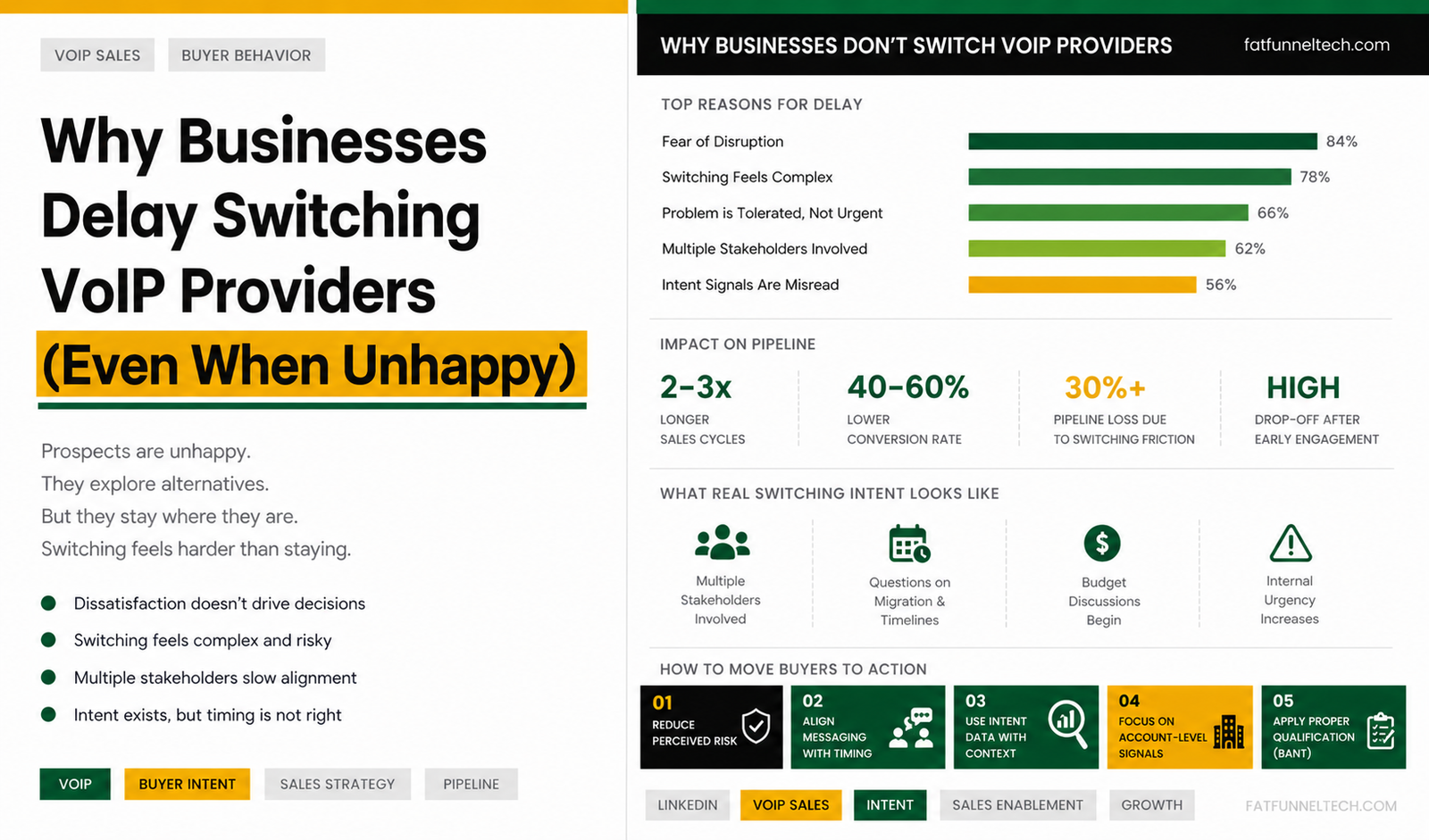
If you sell VoIP solutions, you’ve seen this before.
Prospects complain about their current provider.
They talk about poor call quality.
They mention lack of support.
They even explore alternatives.
Everything signals dissatisfaction.
But when it comes to switching?
They stay where they are.
No decision. No movement.
It feels irrational.
But it’s not.
Businesses don’t delay switching because they’re satisfied.
They delay because switching feels harder than staying.
The Reality of VoIP Friction
On the surface, changing a VoIP provider sounds simple.
In reality, it touches:
- Communication systems
- Customer interactions
- Internal workflows
- IT infrastructure
Even small disruptions can affect daily operations.
So even unhappy customers hesitate.
Because the cost of change feels bigger than the cost of staying.
Why Businesses Don’t Switch
1. Fear of disruption
Communication is critical.
Any downtime means:
- Missed calls
- Lost business
- Operational issues
Even if your solution is better, the fear of disruption slows decisions.
2. Switching feels complex
Businesses worry about:
- Number porting
- System setup
- Integration with existing tools
- Employee adoption
If the process is unclear, they delay.
Not because they don’t want change.
But because they don’t understand it.
3. The problem is tolerated, not urgent
Poor call quality is frustrating.
But if operations are still running, it’s not always urgent.
Businesses prioritize:
- Revenue-generating activities
- Immediate operational issues
VoIP problems often sit in the background.
Until they become critical.
4. Decision-making involves multiple stakeholders
Switching providers is not a single-person decision.
It involves:
- IT teams
- Operations
- Finance
- Leadership
Each group has concerns.
Alignment takes time.
And until that happens, decisions get delayed.
5. Intent signals are misread
VoIP companies often see:
- Website visits
- Content engagement
- Demo requests
And assume readiness.
But many buyers are:
- Exploring options
- Benchmarking vendors
- Preparing for future decisions
Intent exists.
But timing is not aligned.
The Switching Gap
This creates a gap between:
- Dissatisfaction
- Decision
Businesses can be unhappy for months or even years.
Without taking action.
Because switching requires:
- Confidence
- Clarity
- Low perceived risk
Without these, they stay.
What Real Switching Intent Looks Like
Not all unhappy customers are ready to move.
True intent shows when:
- Multiple stakeholders get involved
- Questions shift toward migration and timelines
- Budget discussions begin
- Internal urgency increases
These signals are fewer.
But far more meaningful.
Where Most VoIP Campaigns Go Wrong
1. Focusing only on pain points
Highlighting problems is easy.
But buyers already know their issues.
What they need is confidence in the solution.
2. Ignoring the switching journey
Most campaigns sell the product.
Few address:
- How switching works
- How risk is minimized
- What support looks like
Without this, hesitation remains.
3. Engaging too early
When sales pushes too soon:
- Buyers feel pressured
- Trust drops
- Conversations stall
Timing matters more than speed.
4. Lack of sales and marketing alignment
Marketing generates interest.
Sales expects readiness.
Without alignment on:
- What intent means
- When to engage
Leads get mishandled.
How to Move Buyers from Interest to Action
1. Reduce perceived risk
Show clearly:
- How switching works
- What the transition looks like
- How disruption is minimized
Clarity builds confidence.
2. Align messaging with timing
Early-stage buyers need:
- Education
- Insights
Late-stage buyers need:
- Proof
- Assurance
Matching the message improves conversion.
3. Use intent data with context
Intent data helps identify:
- Who is exploring
- When interest increases
But it must be interpreted.
Not every signal means readiness.
4. Focus on account-level signals
One person engaging is not enough.
Look for:
- Multiple stakeholders involved
- Cross-team activity
This indicates stronger intent.
5. Apply proper qualification
Frameworks like BANT help when used correctly.
Focus on:
- Decision authority
- Urgency
- Timeline
Without this, leads stay unqualified.
The Real Issue
Businesses don’t delay switching because they’re comfortable.
They delay because change feels risky.
When teams only focus on selling benefits and ignore switching barriers, deals don’t move.
Final Thought
In VoIP sales, dissatisfaction is not enough.
Interest is not enough.
Even intent is not enough.
What drives decisions is confidence.
Confidence that switching is worth it.
Confidence that risk is low.
Confidence that the outcome is better.
The teams that win are not the ones who highlight problems.
They are the ones who remove hesitation.
Leave a Reply