

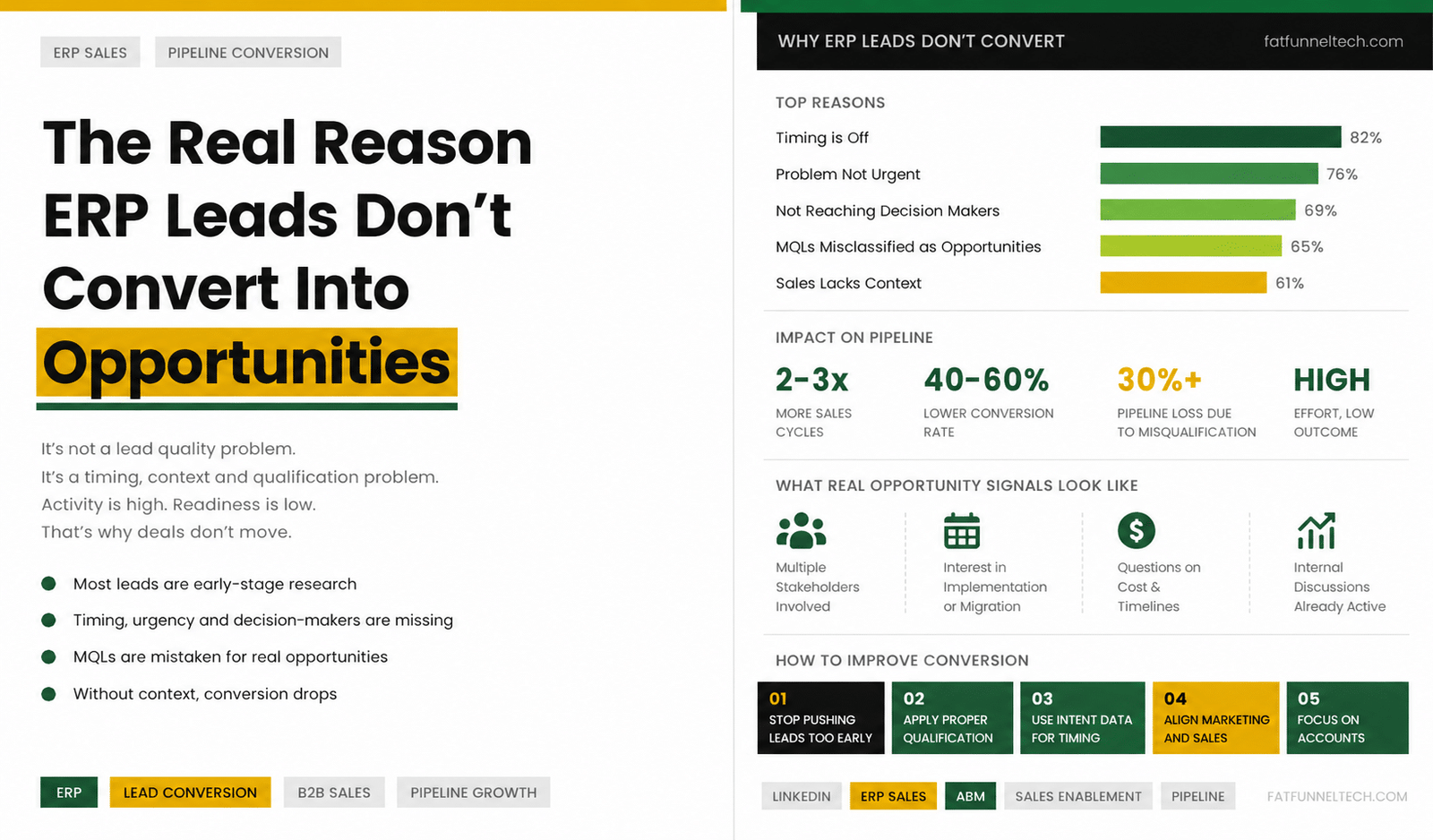
ERP companies rarely struggle with lead generation.
There’s always activity.
Whitepaper downloads.
Demo requests.
Inbound queries.
On the surface, everything looks healthy.
But when you look at pipeline?
Conversion drops.
Leads don’t move forward. Opportunities don’t build.
And sales starts questioning lead quality.
So what’s the real issue?
It’s not that ERP leads are bad.
It’s that most of them were never real opportunities to begin with.
The Illusion of ERP Demand
ERP is a high-consideration purchase.
Companies don’t buy ERP systems casually.
They explore.
They research.
They evaluate long before they decide.
So when someone downloads ERP-related content, it often means:
- They are understanding the landscape
- They are benchmarking solutions
- They are preparing for a future initiative
But marketing often treats this as immediate intent.
That’s where the gap begins.
Why ERP Leads Don’t Turn Into Opportunities
1. Timing is completely off
ERP decisions are tied to business cycles.
Things like:
- Financial year planning
- System upgrades
- Business expansion
If a lead is not aligned with these timelines, nothing moves.
You might have the right account.
But at the wrong time.
2. The problem is not urgent
ERP solves big problems.
But not always urgent ones.
A company might know their system is outdated.
But unless it is:
- Breaking operations
- Causing financial loss
- Blocking growth
It won’t get priority.
So interest exists. Action does not.
3. You’re not reaching the real decision-makers
ERP buying groups are complex.
They include:
- IT teams
- Finance leaders
- Operations heads
- Leadership
Most leads come from:
- Mid-level managers
- System users
- Analysts
They influence decisions.
But they don’t drive them.
Without access to leadership, deals stall early.
4. MQLs are mistaken for opportunities
This is one of the biggest issues.
ERP marketing teams rely on:
- Form fills
- Webinar registrations
- Content engagement
These signals create MQLs.
But they don’t confirm:
- Budget
- Authority
- Timeline
So when these leads reach sales, they are not ready.
And conversion drops.
5. Sales engages without context
Sales teams often receive leads with limited insight.
They know:
- The company
- The contact
- The activity
But not:
- Why the company is exploring ERP
- What problem they are trying to solve
- Whether there is an active initiative
So conversations stay generic.
And buyers lose interest.
The Hidden Gap Between Interest and Opportunity
Most ERP funnels are built around activity.
More engagement is seen as progress.
But in reality:
Activity ≠ Intent
Intent ≠ Opportunity
An opportunity only exists when:
- There is a clear problem
- There is urgency
- There is alignment across stakeholders
Without this, leads stay stuck.
What Real Opportunity Signals Look Like
In ERP sales, real intent shows up differently.
You’ll often see:
- Multiple stakeholders involved in conversations
- Interest in implementation or migration
- Questions around cost and timelines
- Internal discussions already in motion
These signals are fewer.
But far more valuable.
How to Improve ERP Lead Conversion
1. Stop pushing leads too early
Not every lead needs immediate sales outreach.
Early-stage leads should be:
- Educated
- Nurtured
- Tracked over time
Rushing them into sales reduces conversion.
2. Apply proper qualification
Frameworks like BANT are useful when applied realistically.
Focus on:
- Who owns the decision
- Whether there is an active initiative
- When the decision is expected
Without this, qualification stays surface-level.
3. Use intent data for timing, not just targeting
Intent data helps identify:
- When accounts start researching
- When interest increases
- When evaluation begins
But it needs interpretation.
Not every signal means “ready to buy.”
4. Align marketing and sales
Marketing creates demand.
Sales converts it.
Both need to agree on:
- What defines a qualified lead
- When to engage
- How to approach the account
Without alignment, leads get wasted.
5. Focus on accounts, not just leads
ERP deals are account-driven.
One contact is not enough.
You need to:
- Identify the buying group
- Engage multiple stakeholders
- Build internal momentum
This is where ABM becomes critical.
The Real Problem
ERP leads don’t fail because they lack interest.
They fail because they lack readiness.
When teams confuse early research with buying intent, they create false expectations.
Sales chases leads that are not ready.
Marketing reports success based on activity.
And pipeline suffers.
Final Thought
ERP is not a volume game.
It’s a timing and qualification game.
The goal is not to generate more leads.
It’s to identify which leads can actually become opportunities.
Because in ERP sales, the difference between interest and opportunity is not small.
It’s everything.
Leave a Reply