

Enterprise cloud deals often start strong.
There is interest.
There is engagement.
There is even a first conversation.
Everything looks promising.
But then something changes.
Follow-ups slow down.
Responses become delayed.
Momentum disappears.
And the deal stalls.
This is one of the most common challenges in cloud sales.
Not because the buyer lost interest.
But because the first contact was not enough to move the deal forward.
The Illusion of a Strong Start
That first meeting creates confidence.
The prospect shows interest.
They ask questions.
They explore your solution.
It feels like progress.
But in enterprise cloud sales, first contact is just the beginning.
Not the turning point.
Because behind that initial interaction, the real decision process has not even started.
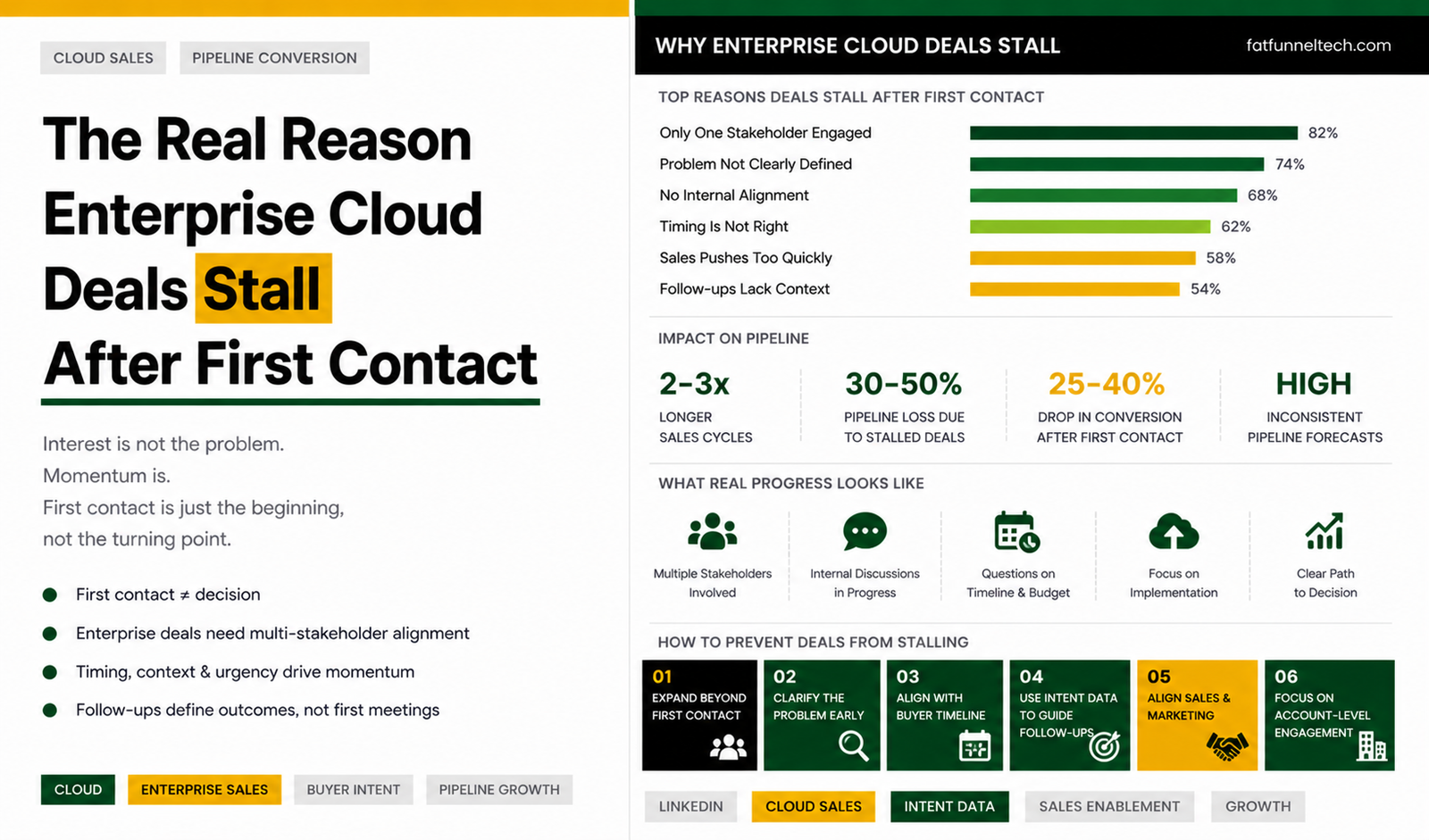
Why Deals Stall After First Contact
1. You’ve only engaged one stakeholder
Enterprise cloud deals are never single-threaded.
The first contact is often:
- A technical evaluator
- A mid-level manager
- A team lead
They can explore.
But they cannot decide.
Without engaging:
- Finance
- Security
- Leadership
The deal has no momentum.
2. The problem is not clearly defined
A prospect may be interested in your solution.
But if the problem is not urgent or clearly framed, it loses priority.
After the first call, they go back to daily operations.
And your solution becomes just another option.
3. No internal alignment exists
Even if one stakeholder is convinced, others may not be aware.
Enterprise decisions require:
- Cross-team alignment
- Internal discussions
- Approval processes
If this alignment is missing, deals pause.
Not because of rejection.
But because of uncertainty.
4. Timing is not right
Cloud investments are tied to:
- Budget cycles
- Migration plans
- Business priorities
If your outreach does not align with these timelines, interest fades.
You may have entered too early.
Or sometimes too late.
5. Sales pushes too quickly
After a good first call, sales often tries to accelerate the deal.
They push for:
- Demos
- Proposals
- Next steps
But the buyer is still evaluating.
This creates pressure.
And instead of moving forward, the buyer steps back.
6. Lack of context in follow-up
Many follow-ups are generic.
They repeat:
- Product features
- Company credentials
But they don’t address:
- The buyer’s specific challenge
- Their internal situation
- Their decision process
Without relevance, engagement drops.
The Gap Between Interest and Momentum
This is where most deals fail.
Interest exists.
But momentum does not.
Momentum requires:
- Multiple stakeholders engaged
- A clear problem defined
- Internal urgency
- A path to decision
Without these, the deal stays stuck after first contact.
What Real Progress Looks Like
A deal is moving when you see:
- New stakeholders joining conversations
- Discussions shifting toward implementation
- Questions around timelines and budget
- Internal meetings happening on the buyer side
These signals show movement.
Not just interest.
How to Prevent Deals from Stalling
1. Expand beyond the first contact
Don’t rely on one stakeholder.
Map the buying group.
Engage:
- Decision-makers
- Influencers
- Evaluators
This builds momentum across the account.
2. Clarify the problem early
In the first conversation, focus on:
- What problem exists
- Why it matters now
- What happens if it is not solved
This creates urgency.
3. Align with the buyer’s timeline
Instead of pushing your sales cycle, understand theirs.
Ask:
- When are decisions planned?
- What internal steps are required?
This improves timing.
4. Use intent data to guide follow-ups
Intent data helps identify:
- Ongoing research
- Increased engagement
- Movement toward evaluation
This adds context to your outreach.
5. Align sales and marketing
Marketing creates initial engagement.
Sales builds relationships.
Both teams need to:
- Share insights
- Track account behavior
- Understand buying stages
Without this, follow-ups lack direction.
6. Focus on account-level engagement
Enterprise deals are not about individual leads.
Look for:
- Activity across multiple stakeholders
- Consistent engagement from the account
This indicates real opportunity.
The Real Issue
Enterprise cloud deals don’t stall because of lack of interest.
They stall because:
- Engagement is limited
- Context is missing
- Alignment is weak
The first contact creates visibility.
But it does not create commitment.
Final Thought
In enterprise cloud sales, the first conversation is not the hardest part.
Keeping the deal moving is.
The goal is not just to generate interest.
It’s to build momentum.
Because deals don’t move forward after one conversation.
They move forward when the entire account is ready to act.
Leave a Reply