

In B2B marketing, activity looks like progress.
More website visits.
More content downloads.
More engagement across channels.
Dashboards start to look strong.
But pipeline?
Still inconsistent.
Deals don’t move as expected. Conversion stays low.
This is where most teams face a hard truth.
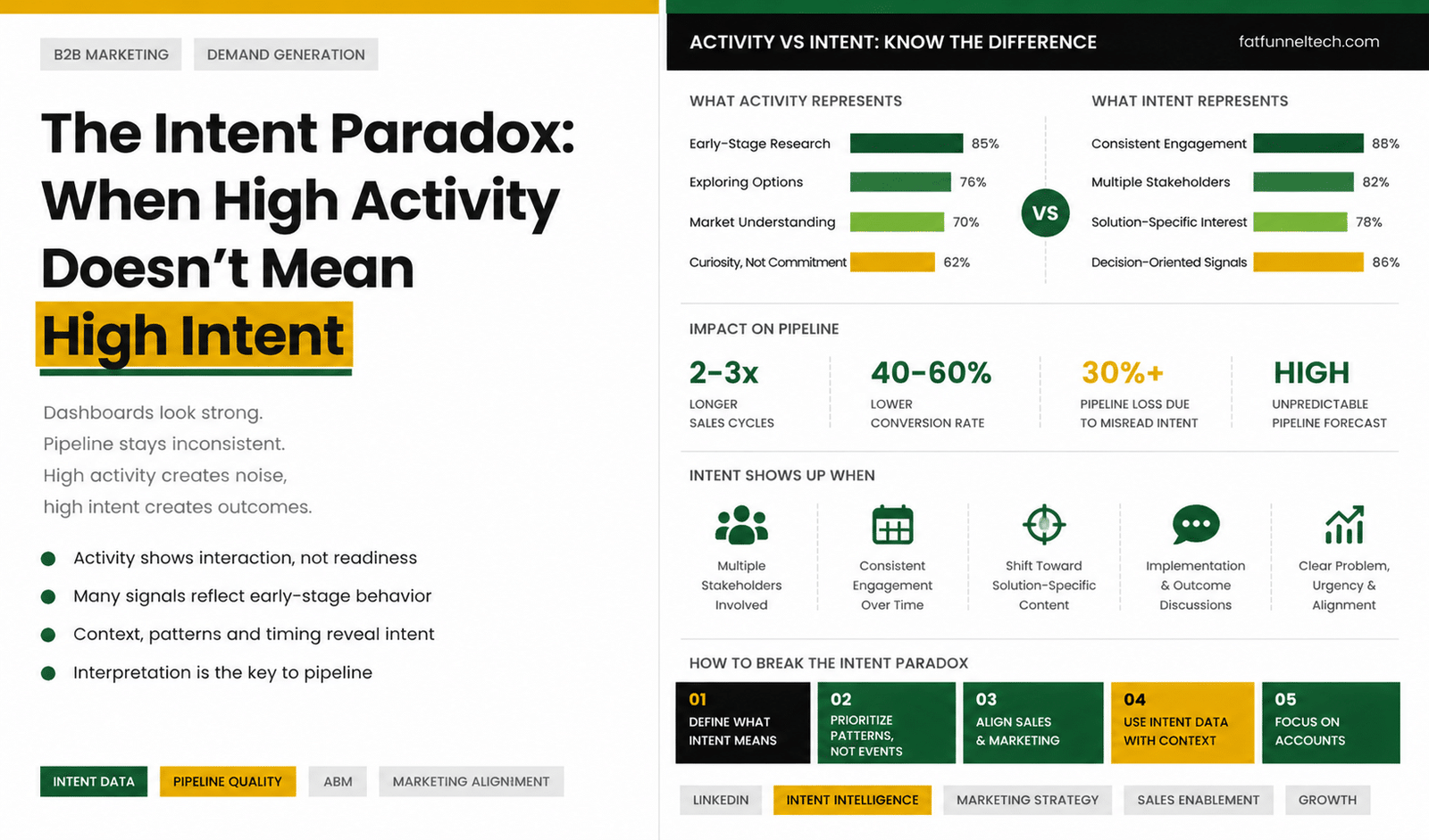
High activity does not mean high intent.
And confusing the two creates one of the biggest gaps in modern demand generation.
Why Activity Feels Like Intent
Activity is easy to measure.
You can track:
- Page visits
- Clicks
- Time on site
- Content engagement
These metrics give a sense of momentum.
They answer:
“Are people interacting with us?”
But they don’t answer:
“Are people ready to buy?”
That’s the paradox.
What Activity Actually Represents
Most activity comes from early-stage behavior.
Buyers are:
- Researching options
- Exploring trends
- Understanding the market
This is important.
But it’s not commitment.
A spike in activity often reflects curiosity.
Not decision-making.
Where Teams Go Wrong
1. Treating engagement as readiness
A lead downloads multiple assets.
Marketing flags it as high intent.
Sales reaches out expecting a serious conversation.
The buyer is still exploring.
The result?
Low response. Delayed conversations. Lost momentum.
2. Overvaluing volume
More activity creates a sense of success.
Campaigns look effective.
Reports show growth.
But if that activity doesn’t translate into pipeline, it becomes misleading.
3. Ignoring buying stages
Not all engagement is equal.
Early-stage:
- Blog reads
- General content consumption
Late-stage:
- Product comparisons
- Pricing-related interest
- Implementation discussions
When these stages are not differentiated, activity gets misinterpreted.
4. Lack of context behind signals
Data without context creates confusion.
A company might show high activity because:
- Multiple people are researching
- They are benchmarking vendors
- They are preparing for future decisions
Without understanding why activity is happening, intent cannot be defined.
The Difference Between Noise and Signal
High activity creates noise.
Intent creates direction.
Intent is visible when:
- Engagement is consistent over time
- Multiple stakeholders are involved
- Interest shifts toward solution-specific content
- Conversations move toward implementation or outcomes
These signals are fewer.
But they are meaningful.
Why This Problem Is Growing
With more tools and platforms, tracking activity has become easier.
Every interaction is captured.
Every click is measured.
But this creates an overload of signals.
Without a clear framework, teams treat all signals equally.
And that leads to poor prioritization.
The Impact on Pipeline
When activity is mistaken for intent:
- Sales engages too early
- Buyers feel pressured
- Conversion rates drop
- Pipeline becomes unpredictable
It’s not a data problem.
It’s an interpretation problem.
How to Break the Intent Paradox
1. Define what intent actually means
Teams need a shared understanding of intent.
Not just activity levels.
But:
- Buying stage
- Urgency
- Stakeholder involvement
Without this definition, signals remain unclear.
2. Prioritize patterns, not events
One action means little.
Patterns over time mean something.
Look for:
- Repeated engagement
- Depth of interaction
- Cross-channel behavior
This is where intent becomes visible.
3. Align marketing and sales
Marketing sees activity.
Sales needs readiness.
Both teams must agree on:
- When a lead becomes qualified
- When outreach should happen
This alignment improves conversion.
4. Use intent data with interpretation
Intent data adds another layer.
But it still needs context.
It should help answer:
- Why now
- What problem is being explored
- How close the account is to decision
Without interpretation, it becomes just another signal.
5. Focus on accounts, not individuals
Intent often shows up across an account.
One contact engaging is not enough.
Multiple stakeholders interacting is a stronger indicator.
This is where ABM plays a key role.
The Real Meaning of Intent
Intent is not about how much activity exists.
It’s about what that activity represents.
It answers:
- Is there a real problem?
- Is there urgency?
- Is there alignment to act?
Without these elements, activity stays at the surface.
Final Thought
High activity feels good.
It shows movement.
But movement without direction does not create outcomes.
The goal is not to increase activity.
It’s to understand it.
Because in B2B, especially in complex sales, the difference between noise and intent defines pipeline success.
And the teams that win are not the ones with the most activity.
They are the ones who know what it actually means.
Leave a Reply