

Cloud companies rarely struggle with generating leads.
Campaigns are running.
Content is performing.
MQL numbers look strong.
On reports, everything seems to be working.
But when you look at SQLs?
There’s a drop.
Leads don’t convert. Sales conversations don’t progress. Pipeline feels inconsistent.
This is where most cloud teams get stuck.
Not because they lack demand.
But because there’s a hidden gap between MQLs and SQLs.
What MQLs Actually Represent
An MQL is often triggered by:
- Content downloads
- Webinar registrations
- Website engagement
- Email interactions
These are signals of interest.
They show that someone is paying attention.
But they don’t confirm:
- Buying intent
- Urgency
- Decision readiness
So while MQL volume may be high, real opportunity is still unclear.
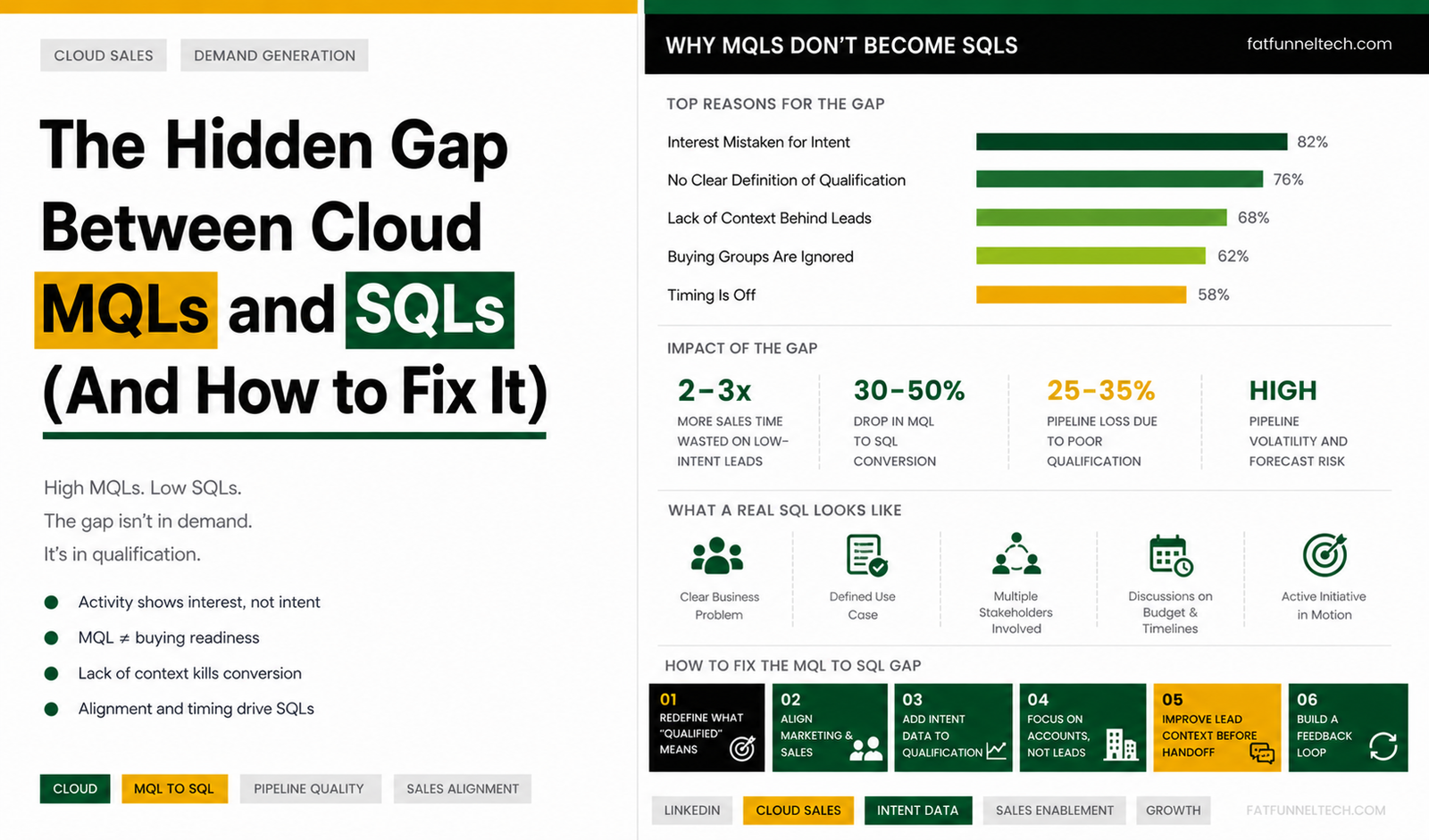
Why MQLs Don’t Become SQLs
1. Interest is mistaken for intent
This is the most common issue.
A prospect engages with your content.
Marketing scores them as qualified.
Sales reaches out expecting a meaningful conversation.
But the buyer is still exploring.
The timing doesn’t match.
2. No clear definition of qualification
Marketing and sales often define “qualified” differently.
Marketing looks at:
- Engagement
- Activity
- Scoring models
Sales looks at:
- Budget
- Authority
- Timeline
Without a shared definition, leads get passed too early.
3. Lack of context behind the lead
Sales teams often receive leads with limited insight.
They know:
- Who the contact is
- What activity happened
But not:
- Why the prospect engaged
- What problem they are trying to solve
- Whether there is an active initiative
So conversations stay surface-level.
4. Buying groups are ignored
Cloud purchases involve multiple stakeholders.
- IT teams
- Security teams
- Finance
- Leadership
An MQL is usually a single contact.
An SQL requires alignment across the group.
Without that, deals don’t move forward.
5. Timing is off
Cloud decisions are tied to:
- Budget cycles
- Migration plans
- Business priorities
If a lead is not aligned with these timelines, conversion drops.
You may have the right account.
But at the wrong time.
The Cost of This Gap
When MQLs don’t convert into SQLs:
- Sales wastes time on low-intent leads
- Marketing reports inflated success
- Pipeline becomes unpredictable
- Revenue targets get harder to achieve
It’s not just a conversion problem.
It’s a pipeline quality problem.
What a Real SQL Looks Like
An SQL is not just an engaged lead.
It’s a qualified opportunity.
You’ll often see:
- Clear business problem
- Defined use case
- Multiple stakeholders involved
- Early discussions around budget or timelines
These signals are fewer.
But far more reliable.
How to Fix the MQL to SQL Gap
1. Redefine what “qualified” means
MQL should not be based only on activity.
It should include:
- ICP fit
- Buying stage
- Intent signals
This reduces noise.
2. Align marketing and sales
Both teams need to agree on:
- What qualifies as an MQL
- When a lead becomes an SQL
- How leads should be handled
Without alignment, the gap remains.
3. Add intent data to qualification
Intent data helps identify:
- When accounts start researching
- When interest increases
- When evaluation begins
This adds depth beyond basic engagement.
4. Focus on accounts, not just leads
Cloud deals are account-driven.
Instead of looking at one contact, track:
- Multiple stakeholders
- Engagement across the account
This improves qualification.
5. Improve lead context before handoff
Sales needs more than activity data.
Provide insights like:
- What content was consumed
- What problem the lead might be exploring
- Where they are in the buying journey
This makes outreach more relevant.
6. Build a feedback loop
Sales knows which leads convert.
Marketing controls how leads are generated.
If feedback is shared:
- Targeting improves
- Messaging gets sharper
- Conversion rates increase
Without this, the same mistakes repeat.
The Real Problem
Cloud teams don’t have an MQL problem.
They have a qualification problem.
When activity is treated as readiness, leads get pushed too early.
And when leads are not ready, sales cannot convert them.
Final Thought
The gap between MQLs and SQLs is not visible in dashboards.
But it shows up in pipeline.
Fixing it is not about generating more leads.
It’s about understanding which leads actually matter.
Because in cloud sales, volume does not drive revenue.
Qualified opportunities do.
Leave a Reply