

Infrastructure tech deals don’t fail early.
They stall slowly.
A conversation starts.
Interest builds.
Meetings happen.
Then momentum fades.
No clear rejection.
No clear next step.
Just silence.
This is not a pipeline problem.
It’s a buying committee problem.
One Deal. Too Many Voices.
Infrastructure decisions are never individual.
They involve:
Engineering teams
Procurement
Finance
Operations
Leadership
Each group sees the deal differently.
Each group evaluates risk differently.
So even if one person is convinced, the deal does not move.
Because agreement is missing.
Interest Does Not Mean Alignment
A common mistake.
One stakeholder engages deeply.
They attend demos.
Ask questions.
Show interest.
It feels like progress.
But internally, nothing has changed.
Other stakeholders are:
Not involved
Not convinced
Or not even aware
So the deal pauses.
Not because of lack of interest.
Because of lack of alignment.
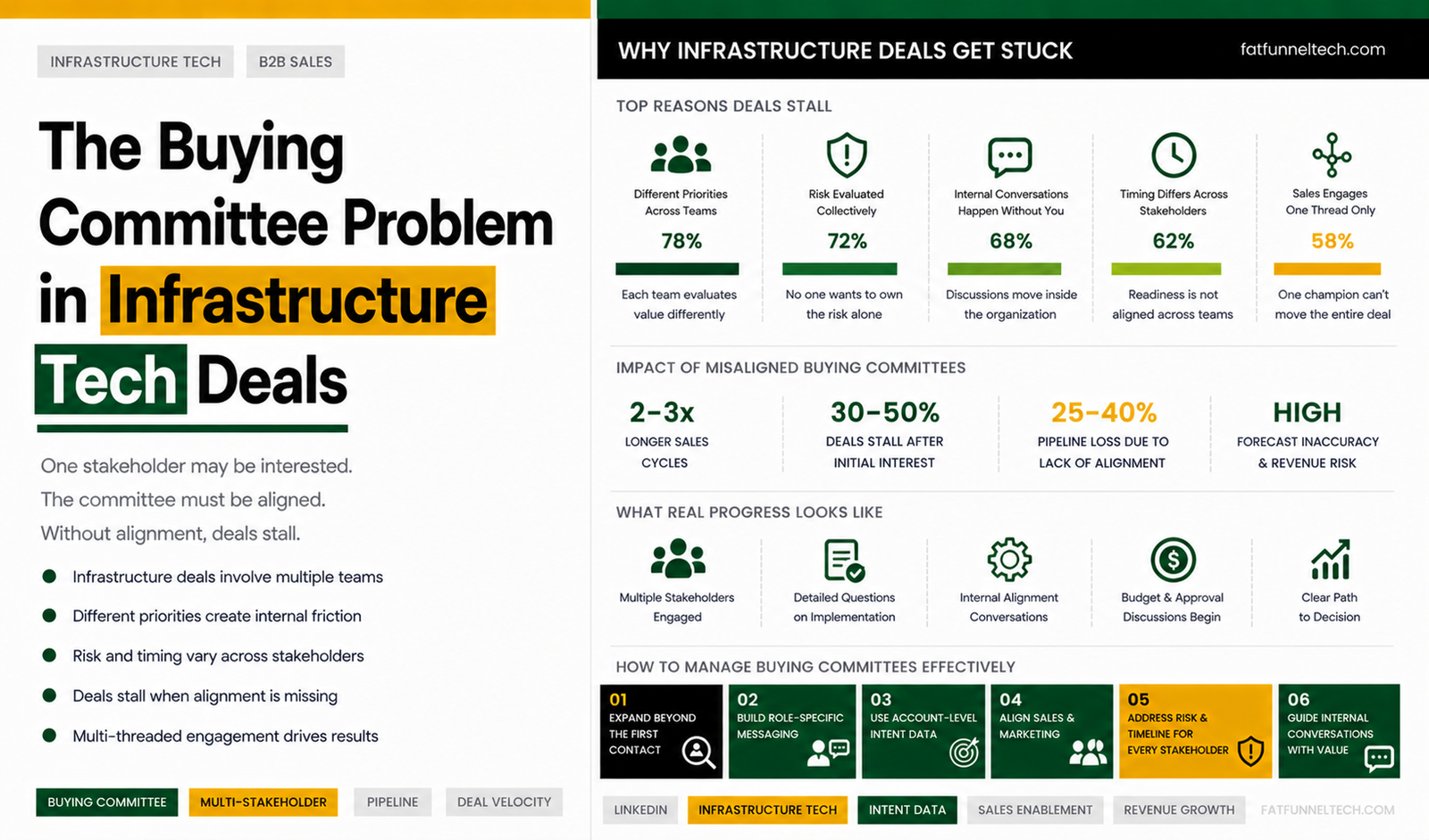
Why Infrastructure Deals Get Stuck
1. Different priorities across teams
Engineering looks for performance.
Finance looks at cost.
Operations looks at implementation impact.
Leadership looks at long term value.
Your solution must satisfy all.
If it solves only one perspective, the deal slows down.
2. Risk is evaluated collectively
Infrastructure decisions carry risk.
System disruption.
Integration challenges.
Operational impact.
No single stakeholder wants to own that risk.
So decisions get delayed.
Until everyone feels confident.
3. Internal conversations happen without you
After the first few calls, discussions move inside.
Teams evaluate:
Alternatives
Internal capabilities
Budget constraints
You are no longer part of the conversation.
And without visibility, deals lose direction.
4. Timing differs for each stakeholder
One team may be ready.
Another may not.
Procurement might need time.
Finance might delay approvals.
Operations might resist change.
So even when intent exists, timing is misaligned.
5. Sales engages one thread only
Most outreach focuses on a single contact.
One champion.
But infrastructure deals are multi-threaded.
Without engaging the full committee, momentum breaks.
The Hidden Gap
This is where most deals fail.
You have:
Interest from one stakeholder
Activity at the surface
Positive early signals
But no internal alignment.
So deals appear active.
But never progress.
What Real Progress Looks Like
A deal is moving when:
Multiple stakeholders join conversations
Discussions shift to implementation
Internal questions become specific
Budget conversations begin
These signals show alignment.
Not just interest.
How to Handle Buying Committees Better
1. Expand beyond your first contact
Do not rely on one champion.
Identify:
Who influences
Who evaluates
Who decides
Engage all of them.
2. Build messaging for each role
Different stakeholders care about different outcomes.
Engineering needs clarity.
Finance needs justification.
Leadership needs impact.
One message does not work for all.
3. Use intent data at the account level
Look for:
Multiple people engaging
Activity across teams
Consistent interaction
This indicates stronger intent.
4. Align sales and marketing
Marketing creates entry.
Sales builds relationships.
Both must track:
Account behavior
Stakeholder engagement
Buying stage
Without this alignment, signals get missed.
5. Guide internal conversations
Do not wait for buyers to align.
Help them.
Share:
Use cases
Implementation clarity
Business impact
Make it easier for them to agree internally.
The Real Problem
Infrastructure deals do not fail because buyers are not interested.
They fail because buyers are not aligned.
Until alignment happens, decisions do not move.
Final Thought
In infrastructure tech, you are not selling to a person.
You are selling to a group.
And groups move slower.
The goal is not just to create interest.
It is to create alignment.
Because deals close when the committee agrees.
Not when one person says yes.
Leave a Reply