

Most HRMS companies target companies that are already hiring.
Job postings go up.
Hiring increases.
Outreach begins.
By that time, you’re not early.
You’re already late.
Because every competitor is looking at the same signals.
And every HRMS vendor is reaching out at the same time.
So what happens?
Buyers get flooded. Conversations become transactional. Differentiation disappears.
The real advantage is not reaching hiring companies.
It’s spotting them before they start hiring.
The Problem With Traditional Hiring Signals
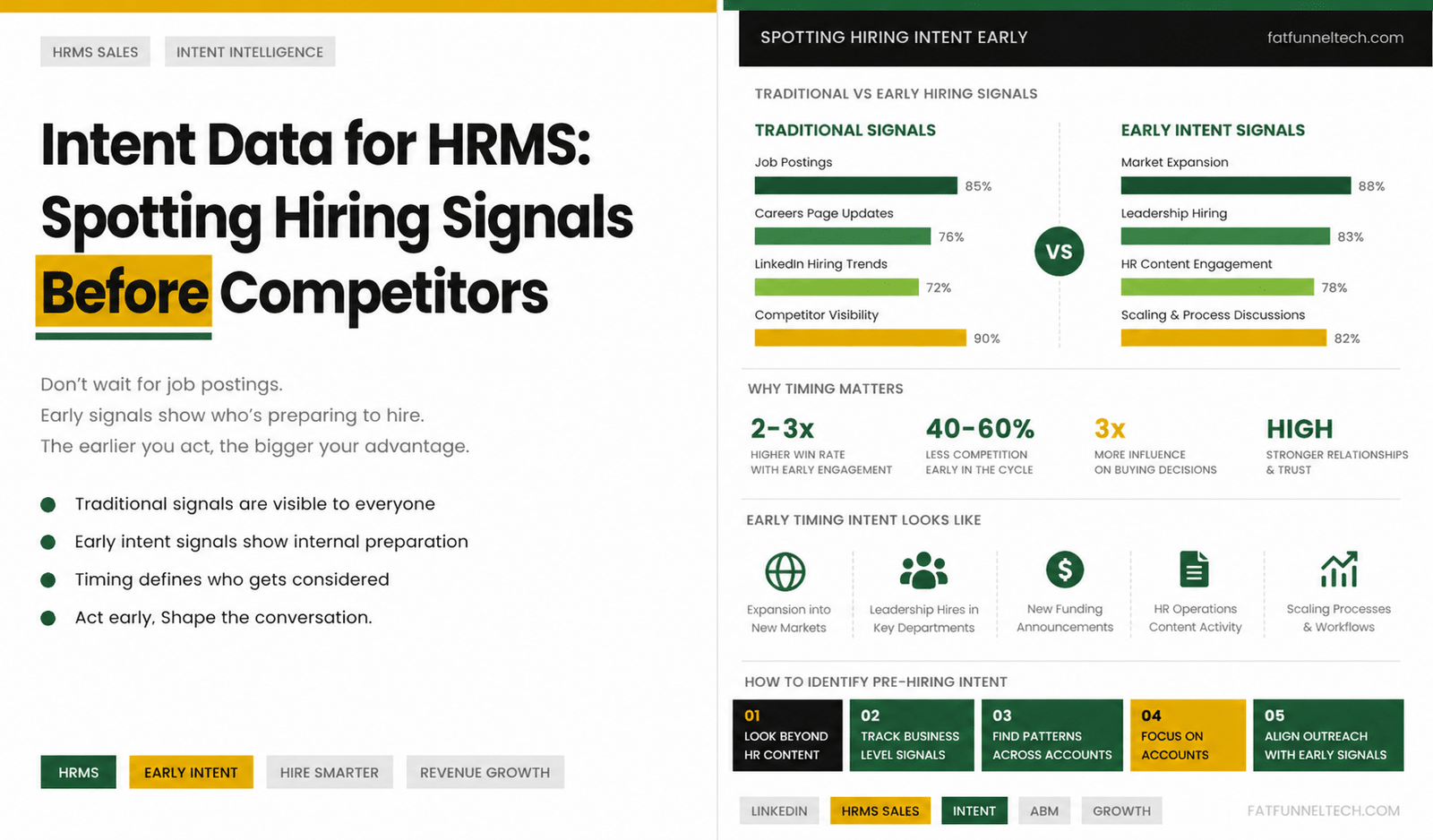
Most HRMS targeting relies on obvious indicators:
- Open job roles
- Careers page updates
- LinkedIn hiring trends
These signals are visible to everyone.
Which means:
- Competition is high
- Outreach is repetitive
- Buyers are overwhelmed
At that stage, you’re not creating demand.
You’re reacting to it.
What Early Hiring Intent Actually Looks Like
Hiring does not start with job postings.
It starts with internal change.
Companies begin preparing before they go public.
You’ll often see:
- Expansion into new markets
- New funding announcements
- Leadership hiring in key departments
- Increased activity around HR operations content
- Discussions around scaling processes
These are early signals.
They indicate preparation, not action.
And this is where intent data becomes powerful.
Why Timing Matters in HRMS Sales
HRMS decisions are not made overnight.
They are tied to:
- Growth plans
- Workforce expansion
- Process complexity
If you reach out after hiring begins, you’re already competing.
If you reach out before hiring begins, you shape the conversation.
That changes everything.
The Gap Most HRMS Teams Miss
Many teams use intent data.
But they use it like footfall data.
They track:
- Content consumption
- Website visits
- Engagement spikes
Without context, these signals don’t mean much.
The real value comes from understanding:
Why is this account showing intent now?
Without that, timing gets missed.
How to Identify Pre-Hiring Intent
1. Look beyond HR content engagement
If a company is consuming content around:
- Workforce planning
- HR automation
- Employee lifecycle management
It may indicate upcoming change.
Not immediate hiring.
But preparation.
2. Track business-level signals
Hiring is a result of business decisions.
Watch for:
- Funding rounds
- Market expansion
- New product launches
- Mergers or acquisitions
These signals often come before hiring spikes.
3. Identify patterns across accounts
One signal means little.
Multiple signals across time mean something.
For example:
- Leadership hiring + HR content engagement + growth announcements
This combination indicates rising intent.
4. Focus on accounts, not individuals
Hiring decisions are not made by one person.
Intent often shows up across teams.
- HR explores tools
- Operations evaluates processes
- Leadership plans expansion
When multiple stakeholders show activity, intent becomes stronger.
5. Align sales outreach with early signals
Reaching out too aggressively at this stage can backfire.
Instead:
- Start with insights
- Share relevant perspectives
- Position yourself as a partner
Not a vendor pushing a product.
Why Competitors Miss This Window
Most HRMS vendors focus on visible demand.
Because it’s easier to track.
But visible demand is crowded.
Early intent requires:
- Better data interpretation
- Strong alignment between marketing and sales
- Patience in engagement
That’s why many teams ignore it.
And that’s where the opportunity lies.
The Role of Intent Data in HRMS Growth
Intent data is not just about identifying buyers.
It’s about identifying timing.
In HRMS, timing defines:
- Who gets considered
- Who gets ignored
- Who gets shortlisted
When used correctly, intent data helps you:
- Enter conversations early
- Build trust before competitors
- Influence decisions before they are finalized
Final Thought
Hiring signals are easy to see.
Real intent is not.
If you wait for job postings, you’re already competing.
If you act on early signals, you’re shaping the decision.
That’s the difference.
Because in HRMS sales, the advantage does not go to the loudest vendor.
It goes to the one that shows up first with relevance.
Leave a Reply