

TravelTech sales rarely happen in isolation.
You’re not selling to a single company.
You’re stepping into a connected system.
Airlines.
Hotels.
OTAs.
Travel agencies.
Technology partners.
All of them are linked.
Yet most ABM campaigns still treat accounts as standalone targets.
And that’s where they fail.
Because in TravelTech, decisions are not made by companies alone.
They are shaped by ecosystems.
The Problem with Traditional ABM in TravelTech
Most ABM strategies follow a simple approach:
- Identify target accounts
- Map decision-makers
- Personalize outreach
This works in many industries.
But in TravelTech, it falls short.
Why?
Because a single account does not operate independently.
A hotel chain depends on:
- Booking platforms
- Payment providers
- Channel managers
An airline relies on:
- Distribution systems
- Partner networks
- Third-party integrations
So even if one company shows intent, the decision often depends on others.
TravelTech Is an Ecosystem Play
Every TravelTech solution touches multiple players.
For example:
A booking solution may impact:
- Hotels
- OTAs
- Payment gateways
A pricing tool may affect:
- Airlines
- Aggregators
- Distribution partners
This means buying decisions are influenced by:
- Compatibility with partners
- Industry standards
- Existing tech stack
So targeting one company without considering its ecosystem limits your impact.
Why Targeting Companies Alone Doesn’t Work
1. Decisions depend on external alignment
A travel company might like your solution.
But if it doesn’t integrate with their partners, adoption slows down.
So even with strong interest, deals get delayed.
2. Multiple stakeholders exist across organizations
In TravelTech, stakeholders are not limited to one company.
You often deal with:
- Internal teams
- External partners
- Technology vendors
Ignoring this network leads to incomplete engagement.
3. Intent signals are distributed
Intent does not show up in one place.
You might see:
- A hotel researching solutions
- An OTA exploring integrations
- A partner evaluating compatibility
Individually, these signals look weak.
Together, they indicate real movement.
4. Sales cycles extend beyond one account
Even if one company is ready, the ecosystem may not be.
So deals stretch.
Not because of lack of interest.
But because alignment is incomplete.
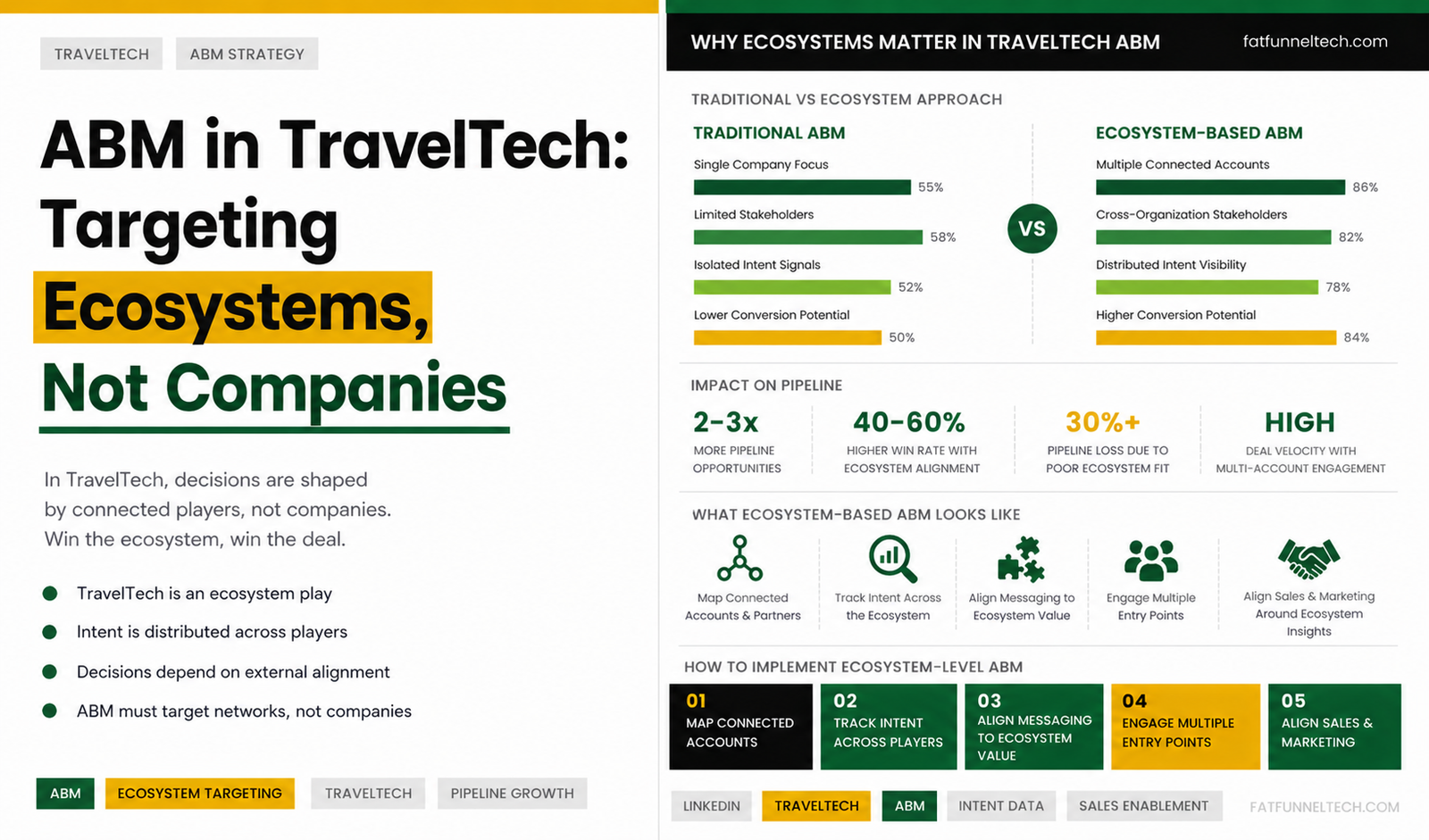
What Ecosystem-Based ABM Looks Like
1. Map connected accounts
Instead of targeting a single company, identify:
- Key partners
- Integration dependencies
- Related stakeholders
This creates a broader view of the opportunity.
2. Track intent across the ecosystem
Look for patterns like:
- Multiple companies researching related solutions
- Increased activity across connected accounts
- Engagement from different parts of the value chain
This signals stronger intent.
3. Align messaging to ecosystem value
Don’t just focus on one company’s benefits.
Show how your solution:
- Fits into existing workflows
- Supports partner integrations
- Enhances overall ecosystem performance
This makes your positioning stronger.
4. Engage multiple entry points
Instead of relying on one contact:
- Start conversations across different stakeholders
- Build awareness across partner networks
- Create momentum beyond a single account
This increases your chances of conversion.
5. Align sales and marketing around ecosystem insights
Marketing identifies patterns.
Sales builds relationships.
Both teams need to:
- Share insights across accounts
- Coordinate outreach
- Understand the bigger picture
Without this, opportunities remain fragmented.
The Role of Intent Data in TravelTech ABM
Intent data becomes more powerful in an ecosystem model.
It helps you:
- Identify clusters of activity
- Spot early signals across connected accounts
- Understand when multiple players are moving together
Instead of focusing on one account’s behavior, you see collective movement.
And that’s where real opportunities emerge.
The Shift TravelTech Teams Need to Make
From:
- Account-level targeting
- Isolated outreach
- Single-threaded engagement
To:
- Ecosystem-level targeting
- Multi-account strategy
- Network-driven engagement
This shift changes how deals are built.
The Real Advantage
Most TravelTech companies still run traditional ABM.
They focus on individual accounts.
They miss the bigger picture.
So when deals stall, they assume lack of interest.
But the real issue is lack of alignment across the ecosystem.
Final Thought
In TravelTech, you are never selling to just one company.
You are selling into a network.
Ignoring that network limits your reach.
Understanding it gives you an advantage.
Because the deals that close are not the ones with the most engagement.
They are the ones where the entire ecosystem is ready.
Leave a Reply