

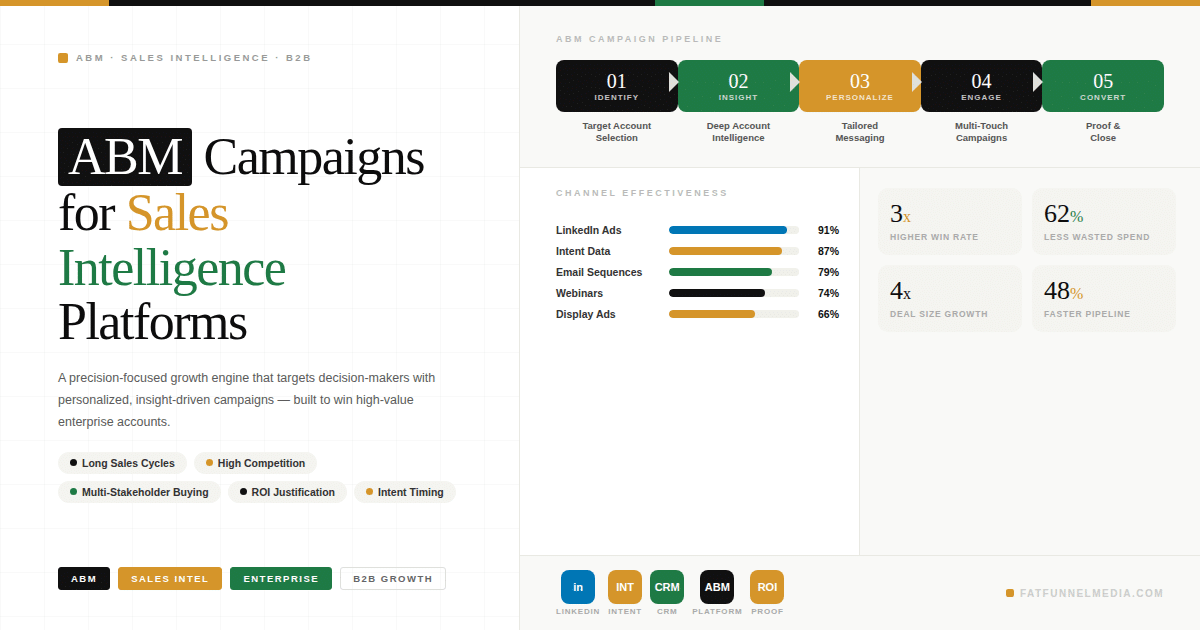
In a highly competitive B2B landscape, sales intelligence platforms are no longer competing on features alone. The real differentiator lies in how effectively they reach, engage, and convert high-value accounts. Traditional demand generation often fails to deliver the precision required to win enterprise deals. This is where Account-Based Marketing becomes a strategic advantage.
For sales intelligence providers, ABM is not just a marketing tactic. It is a focused growth engine designed to target decision-makers with personalized, insight-driven campaigns that align with their revenue goals.
Why ABM is Critical for Sales Intelligence Platforms
Sales intelligence solutions are typically complex, data-driven, and positioned for mid to large enterprises. The buying process involves multiple stakeholders such as sales leaders, revenue operations teams, and executives.
Key challenges include:
- Long sales cycles
- High competition in the market
- Need for strong ROI justification
ABM addresses these challenges by focusing on quality engagement rather than volume.
Define High-Value Target Accounts
The success of any ABM campaign starts with identifying the right accounts. Sales intelligence platforms must focus on organizations that can derive maximum value from their data capabilities.
Criteria for account selection:
- Companies with large sales teams
- Businesses investing in revenue operations
- Organizations using multiple sales tools
- Enterprises looking to improve pipeline efficiency
A well-defined target list ensures better alignment between marketing and sales.
Build Deep Account Intelligence
Before launching campaigns, it is essential to gather detailed insights about each target account.
This includes:
- Current sales stack and tools
- Pain points in lead generation and conversion
- Competitive landscape
- Key decision-makers and influencers
Ironically, sales intelligence platforms must leverage their own capabilities to refine their ABM strategy.
Personalize Messaging at Scale
Personalization is at the core of ABM success. For sales intelligence platforms, messaging should directly address how their solution improves revenue outcomes.
Examples of personalized messaging:
- Highlighting gaps in existing sales data
- Demonstrating how to increase win rates
- Showcasing pipeline acceleration strategies
Tailored messaging creates relevance and drives higher engagement.
Create Multi-Touch Campaigns
Enterprise buyers interact across multiple channels before making decisions. A strong ABM campaign ensures consistent engagement across these touchpoints.
Effective channels include:
- LinkedIn outreach and ads
- Email sequences
- Targeted display campaigns
- Webinars and virtual events
A coordinated approach keeps the brand visible throughout the buying journey.
Align Sales and Marketing Teams
ABM requires seamless collaboration between sales and marketing teams. Both teams must work towards shared account-level goals.
Best practices:
- Shared account insights and dashboards
- Coordinated outreach strategies
- Regular feedback loops
Alignment ensures a unified experience for the prospect.
Showcase Value Through Data and Proof
Sales intelligence platforms must lead with data. Enterprise clients expect clear evidence of impact before making investment decisions.
This can be demonstrated through:
- Case studies with measurable results
- ROI calculators and projections
- Product demos tailored to specific use cases
Proof-driven storytelling builds trust and accelerates decision-making.
Leverage Intent Data for Better Timing
Timing plays a crucial role in ABM success. Using intent data helps identify when target accounts are actively researching solutions.
Benefits include:
- Engaging prospects at the right moment
- Prioritizing high-intent accounts
- Increasing conversion probability
For sales intelligence platforms, this is a natural extension of their core offering.
Measure Campaign Performance
ABM campaigns must be continuously tracked and optimized to ensure effectiveness.
Key metrics to monitor:
- Account engagement levels
- Pipeline contribution
- Deal velocity
- Revenue generated from target accounts
These insights help refine strategies and improve campaign outcomes.
Scale ABM with Technology
As campaigns grow, automation and technology become essential. Sales intelligence platforms can integrate ABM tools to scale their efforts efficiently.
This includes:
- CRM integration
- Marketing automation platforms
- Data enrichment tools
Technology enables consistency while maintaining personalization.
Final Thoughts
ABM campaigns offer a powerful approach for sales intelligence platforms to win high-value enterprise clients. By focusing on targeted engagement, personalized messaging, and data-driven insights, companies can move beyond traditional lead generation and build meaningful relationships with decision-makers.
In a market where precision and relevance define success, ABM provides the strategic edge needed to stand out and drive sustainable growth.
Leave a Reply