

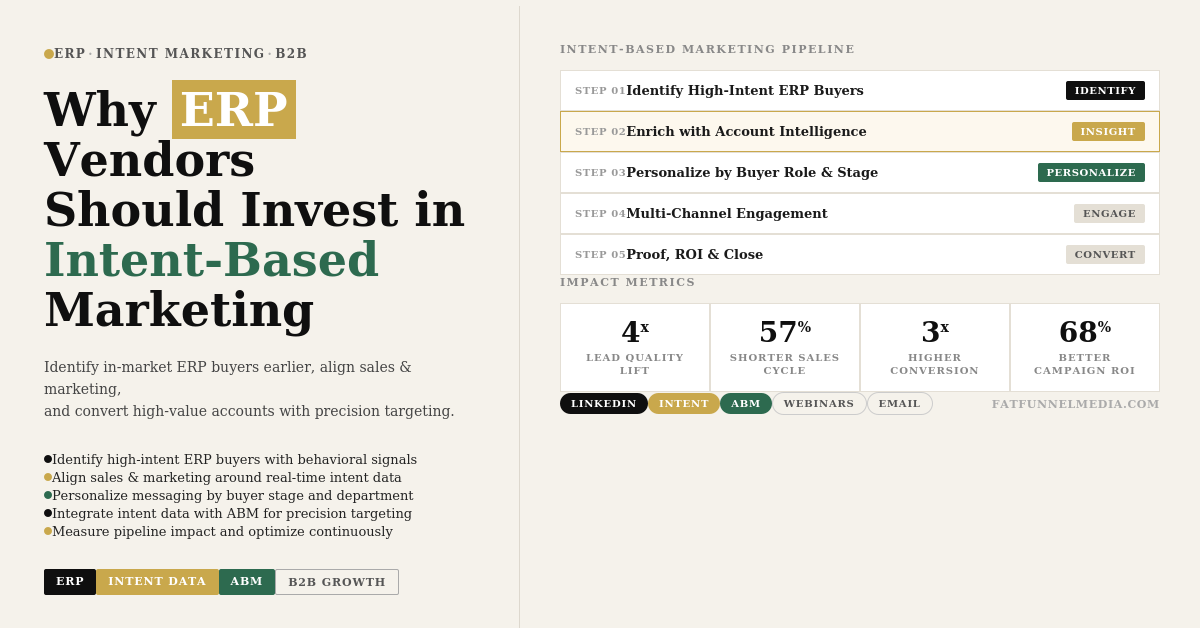
In today’s competitive enterprise software landscape, ERP vendors face increasing pressure to generate high-quality pipeline while navigating long and complex sales cycles. With multiple stakeholders involved and high implementation costs, ERP buying decisions are rarely impulsive.
Traditional marketing approaches often fail to identify prospects at the right stage of the buying journey. This is where intent-based marketing becomes a strategic investment for ERP vendors looking to drive qualified demand and accelerate growth.
The Complexity of ERP Buying Decisions
ERP solutions are mission-critical systems that impact multiple departments including finance, operations, supply chain, and human resources. As a result, the buying process involves:
- Multiple decision-makers
- Extensive research and evaluation
- Long sales cycles
- Strong focus on ROI and scalability
ERP vendors must adopt smarter targeting strategies to engage prospects effectively.
What is Intent-Based Marketing in ERP
Intent-based marketing uses behavioral data signals to identify companies actively researching ERP solutions. These signals are captured through online activities such as content consumption, keyword searches, and engagement with industry platforms.
For ERP vendors, intent data can reveal:
- Companies exploring ERP implementation
- Businesses evaluating system upgrades
- Organizations comparing vendors and solutions
This insight allows vendors to focus on accounts that are already in-market.
Identify High-Intent ERP Buyers
One of the biggest advantages of intent-based marketing is the ability to prioritize accounts showing strong buying signals.
Key indicators include:
- Increased search activity related to ERP systems
- Engagement with competitor content
- Downloads of ERP-related resources
By focusing on high-intent accounts, ERP vendors can improve lead quality and conversion rates.
Improve Sales and Marketing Alignment
Intent data bridges the gap between sales and marketing by providing shared insights into buyer behavior.
ERP vendors can:
- Prioritize outreach based on intent signals
- Align messaging across teams
- Coordinate account-level engagement
This alignment ensures prospects receive consistent and relevant communication.
Deliver Personalized and Relevant Messaging
Generic messaging is ineffective in the ERP space due to the complexity of solutions. Intent-based marketing enables vendors to tailor communication based on specific needs.
Examples:
- Highlighting financial reporting capabilities for finance teams
- Showcasing supply chain optimization for operations leaders
- Demonstrating scalability for growing enterprises
Personalized messaging increases engagement and builds trust.
Enhance ABM Strategies with Intent Data
Intent-based marketing works effectively when integrated with Account-Based Marketing. ERP vendors can use intent signals to refine their ABM efforts and focus on high-value accounts.
Benefits include:
- Better account prioritization
- More targeted campaigns
- Higher ROI on marketing spend
This combination creates a more efficient go-to-market strategy.
Engage Prospects at the Right Time
Timing is critical in ERP sales. Engaging prospects when they are actively researching solutions increases the likelihood of conversion.
Intent data helps:
- Identify early-stage research behavior
- Trigger timely outreach campaigns
- Reduce delays in engagement
This leads to shorter sales cycles and faster deal closures.
Leverage Multi-Channel Campaigns
ERP buyers interact with multiple channels before making decisions. A strong intent-based strategy ensures consistent engagement across touchpoints.
Effective channels include:
- LinkedIn outreach targeting decision-makers
- Email campaigns aligned with buyer intent
- Webinars focused on ERP use cases
- Targeted ads for account visibility
A multi-channel approach keeps the brand top of mind.
Demonstrate Value with Data and Proof
ERP investments require strong justification. Vendors must clearly demonstrate the value of their solutions.
This can be achieved through:
- Case studies with measurable outcomes
- ROI calculators
- Industry-specific success stories
- Product demonstrations
Proof-driven marketing builds credibility and reduces buyer hesitation.
Measure and Optimize Campaign Performance
Continuous tracking is essential to maximize the effectiveness of intent-based marketing.
Key metrics include:
- Engagement levels from target accounts
- Conversion rates of high-intent leads
- Pipeline contribution
- Revenue impact
Data-driven insights help refine strategies over time.
Overcome Challenges in Intent Data Usage
While intent-based marketing offers significant advantages, ERP vendors may face challenges such as data accuracy and integration.
To address these:
- Use reliable intent data providers
- Combine multiple data sources
- Integrate with CRM and marketing automation platforms
A structured approach ensures better results.
Final Thoughts
Intent-based marketing is becoming a critical growth driver for ERP vendors. By identifying in-market buyers and delivering highly relevant messaging, vendors can improve lead quality, accelerate sales cycles, and increase conversion rates.
In a competitive enterprise software market, investing in intent data enables ERP vendors to stay ahead, engage smarter, and build stronger relationships with high-value clients.

Leave a Reply