

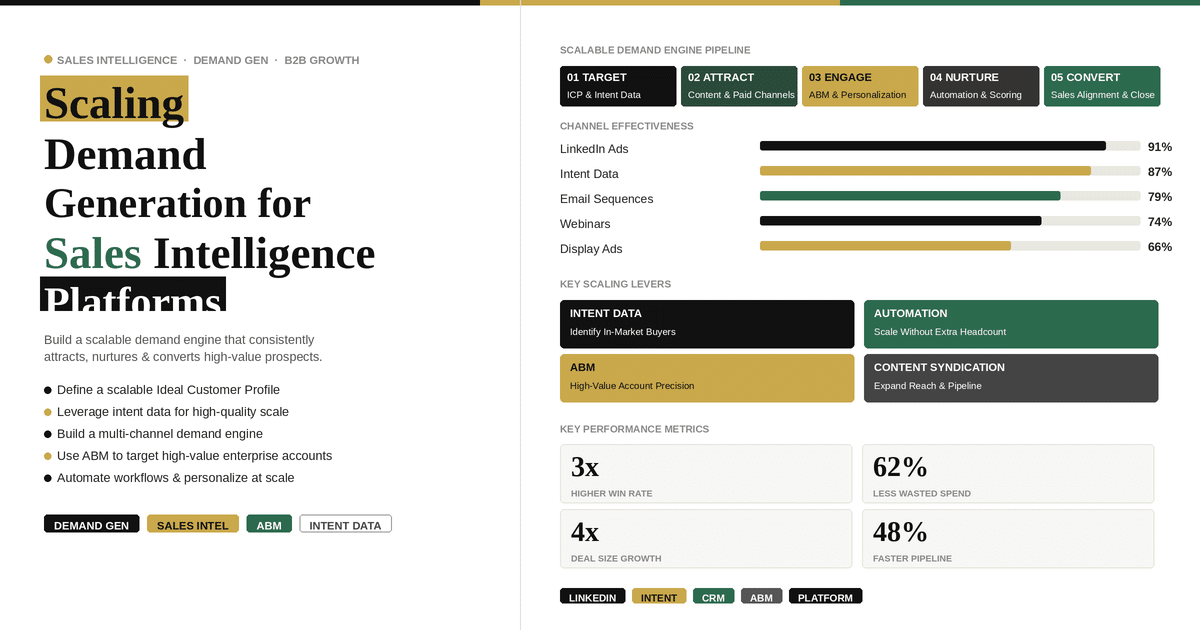
In today’s data-driven B2B ecosystem, sales intelligence platforms are essential for organizations looking to improve prospecting, pipeline visibility, and revenue performance. However, as competition intensifies, scaling demand generation without compromising lead quality has become a major challenge.
For sales intelligence providers, growth is not just about increasing volume. It is about building a scalable demand engine that consistently attracts, nurtures, and converts high-value prospects.
The Challenge of Scaling Demand Generation
Scaling demand generation in the sales intelligence space comes with unique challenges:
- Saturation of similar tools in the market
- Increasing customer acquisition costs
- Long and complex buying cycles
- Need for strong differentiation
To overcome these challenges, companies must adopt a structured and data-driven approach.
Define a Scalable Ideal Customer Profile
Scaling starts with clarity on who to target. Sales intelligence providers should refine their Ideal Customer Profile based on:
- Company size and sales team structure
- Industry and go-to-market model
- Existing tech stack and data tools
- Growth stage and revenue goals
A clear ICP ensures that scaling efforts remain focused and efficient.
Leverage Intent Data for High-Quality Scale
Intent data plays a critical role in scaling demand generation without sacrificing quality.
Key advantages include:
- Identifying accounts actively researching solutions
- Prioritizing high-intent prospects
- Improving campaign targeting
By focusing on in-market buyers, companies can scale efficiently while maintaining lead quality.
Build a Multi-Channel Demand Engine
Scaling requires diversification across multiple channels to maximize reach and engagement.
Effective channels include:
- LinkedIn for targeted B2B outreach
- Paid search for high-intent keywords
- Email campaigns for nurturing
- Content marketing for organic growth
A multi-channel strategy ensures consistent pipeline generation.
Invest in Content That Scales
Content is a key driver of scalable demand generation. Sales intelligence providers should create assets that can be repurposed and distributed across channels.
Examples include:
- Case studies showcasing revenue impact
- Whitepapers on sales efficiency
- Blog content addressing data challenges
- Webinars and on-demand sessions
High-quality content attracts and nurtures prospects at scale.
Use Account-Based Marketing for High-Value Growth
While scaling demand, it is important to focus on high-value accounts. Account-Based Marketing helps target enterprise clients with precision.
Strategies include:
- Identifying key accounts
- Creating personalized campaigns
- Engaging multiple stakeholders
ABM ensures that scaling efforts include both volume and value.
Automate and Optimize Marketing Workflows
Automation is essential for scaling demand generation efficiently.
Sales intelligence companies can:
- Use marketing automation tools for email campaigns
- Implement lead scoring systems
- Automate follow-ups and nurturing sequences
Automation improves efficiency while maintaining consistency.
Align Sales and Marketing for Scale
Scaling demand generation requires strong alignment between sales and marketing teams.
Best practices include:
- Sharing real-time account insights
- Coordinating outreach strategies
- Maintaining consistent messaging
Alignment ensures that increased demand translates into actual revenue.
Personalize at Scale
Even when scaling, personalization remains critical. Data-driven insights enable companies to deliver relevant messaging at scale.
Examples:
- Segment-based email campaigns
- Personalized landing pages
- Role-specific messaging
Balancing scale with personalization improves engagement and conversions.
Measure and Optimize Continuously
Scaling demand generation is an ongoing process that requires continuous optimization.
Key metrics to track:
- Cost per lead
- Conversion rates
- Pipeline contribution
- Customer acquisition cost
Data-driven insights help refine strategies and improve performance.
Expand Through Partnerships and Syndication
Partnerships and content syndication can accelerate scaling efforts.
Opportunities include:
- Collaborating with B2B media platforms
- Partnering with complementary technology providers
- Leveraging industry networks
These channels expand reach and generate additional demand streams.
Final Thoughts
Scaling demand generation for sales intelligence platforms requires a strategic balance between volume, quality, and efficiency. By leveraging intent data, multi-channel engagement, automation, and personalization, companies can build a robust demand engine that drives sustainable growth.
In a competitive B2B landscape, the ability to scale demand without losing focus on high-value prospects is the key to long-term success.

Leave a Reply