

In a highly competitive CRM market, vendors are constantly looking for smarter ways to identify and engage prospects who are most likely to convert. With long sales cycles and multiple decision-makers involved, traditional lead generation often results in wasted effort and low-quality pipeline.
Intent data is changing this dynamic by enabling CRM vendors to pinpoint high-value buyers who are actively researching solutions. For B2B-focused CRM providers, this approach offers a more precise and efficient path to revenue growth.
The Challenge of Identifying High-Value CRM Buyers
CRM solutions are critical for sales, marketing, and customer success teams. As a result, the buying process is complex and involves stakeholders across departments.
Common challenges include:
- Identifying prospects at the right stage of the buying journey
- Engaging multiple decision-makers
- Differentiating in a crowded market
- Proving ROI and business impact
Without the right insights, vendors risk targeting accounts that are not ready to buy.
What is Intent Data in the CRM Context
Intent data refers to behavioral signals that indicate a company’s interest in specific products or services. These signals are gathered from online activities such as content consumption, keyword searches, and engagement with industry platforms.
For CRM vendors, intent data can reveal:
- Companies exploring CRM implementation
- Businesses looking to switch from existing platforms
- Organizations researching sales and marketing automation
This insight allows vendors to focus on accounts that are already in-market.
Identify High-Intent Accounts with Precision
Intent data enables CRM vendors to prioritize accounts showing strong buying signals.
Key indicators include:
- Increased searches related to CRM solutions
- Engagement with competitor content
- Downloads of CRM-related resources
By focusing on these signals, vendors can build a pipeline of high-quality prospects.
Combine Intent Data with Firmographic Insights
Intent data becomes even more powerful when combined with firmographic data.
CRM vendors should analyze:
- Company size and industry
- Revenue and growth stage
- Technology stack and existing tools
This combination helps identify accounts that are not only interested but also a strong fit for the solution.
Align Sales and Marketing Around Intent Signals
Intent data creates a shared source of truth for both sales and marketing teams.
Best practices include:
- Prioritizing outreach based on intent scores
- Sharing real-time account insights
- Coordinating messaging and campaigns
This alignment ensures consistent and timely engagement with prospects.
Personalize Outreach Based on Buyer Behavior
Personalization is critical in B2B marketing. Intent data allows CRM vendors to tailor their messaging based on what prospects are actively researching.
Examples:
- Highlighting automation features for companies exploring sales efficiency
- Showcasing integration capabilities for businesses evaluating tech stacks
- Demonstrating analytics for organizations focused on data-driven decisions
Relevant messaging increases engagement and builds trust.
Enhance ABM Strategies with Intent Data
Intent data plays a key role in strengthening Account-Based Marketing strategies.
CRM vendors can:
- Identify high-value accounts earlier
- Prioritize accounts with active interest
- Deliver more targeted campaigns
This integration improves campaign effectiveness and ROI.
Engage Across Multiple Channels
Once high-intent accounts are identified, engaging them across multiple channels is essential.
Effective channels include:
- LinkedIn outreach targeting decision-makers
- Email campaigns aligned with intent signals
- Webinars focused on CRM use cases
- Targeted advertising for account visibility
A multi-channel approach ensures continuous engagement.
Showcase Value with Data and Proof
CRM investments require clear justification. Vendors must demonstrate how their solutions deliver measurable results.
This can be done through:
- Case studies with proven outcomes
- ROI calculators
- Industry-specific success stories
- Product demonstrations
Proof-driven engagement builds confidence and accelerates decision-making.
Measure and Optimize Continuously
Tracking the performance of intent-driven strategies is essential for long-term success.
Key metrics include:
- Engagement from high-intent accounts
- Conversion rates
- Pipeline contribution
- Revenue impact
Continuous optimization helps refine targeting and improve outcomes.
Overcome Challenges in Intent Data Usage
While intent data offers significant advantages, CRM vendors may face challenges such as data accuracy and integration.
To address these:
- Use reliable intent data providers
- Combine multiple data sources
- Integrate with CRM and marketing automation tools
A structured approach ensures maximum value.
Final Thoughts
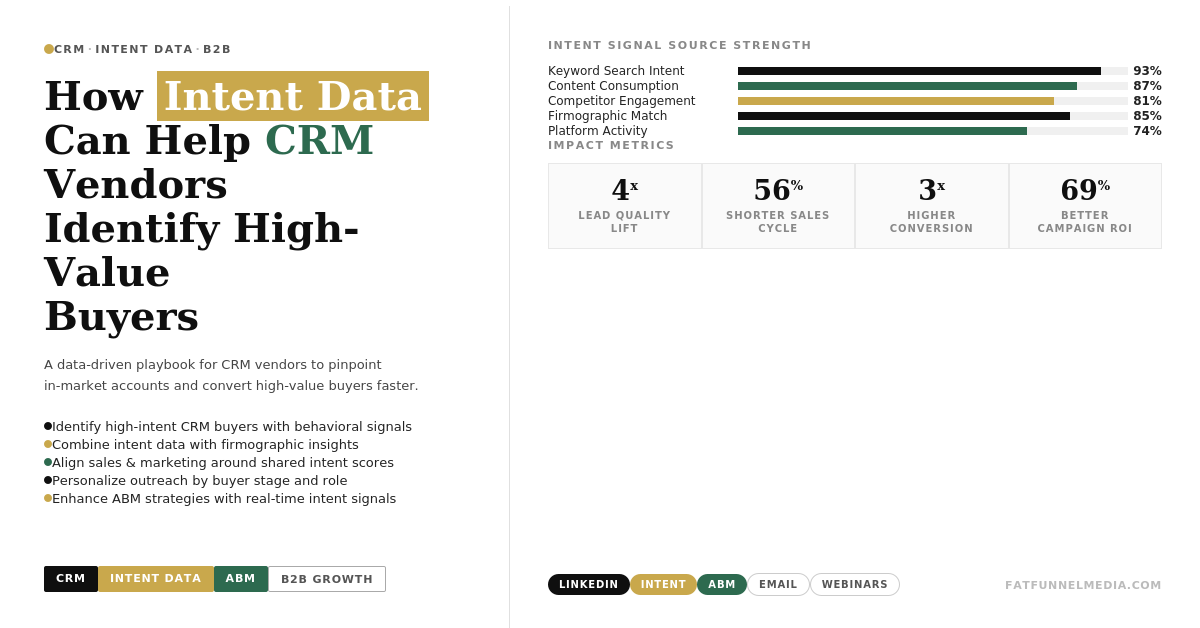
Intent data is becoming a critical tool for CRM vendors looking to identify and engage high-value buyers. By focusing on real-time behavioral signals and delivering personalized engagement, vendors can improve lead quality, shorten sales cycles, and drive better business outcomes.
In a competitive CRM landscape, the ability to act on buyer intent can be the difference between missed opportunities and sustained growth.

Leave a Reply