

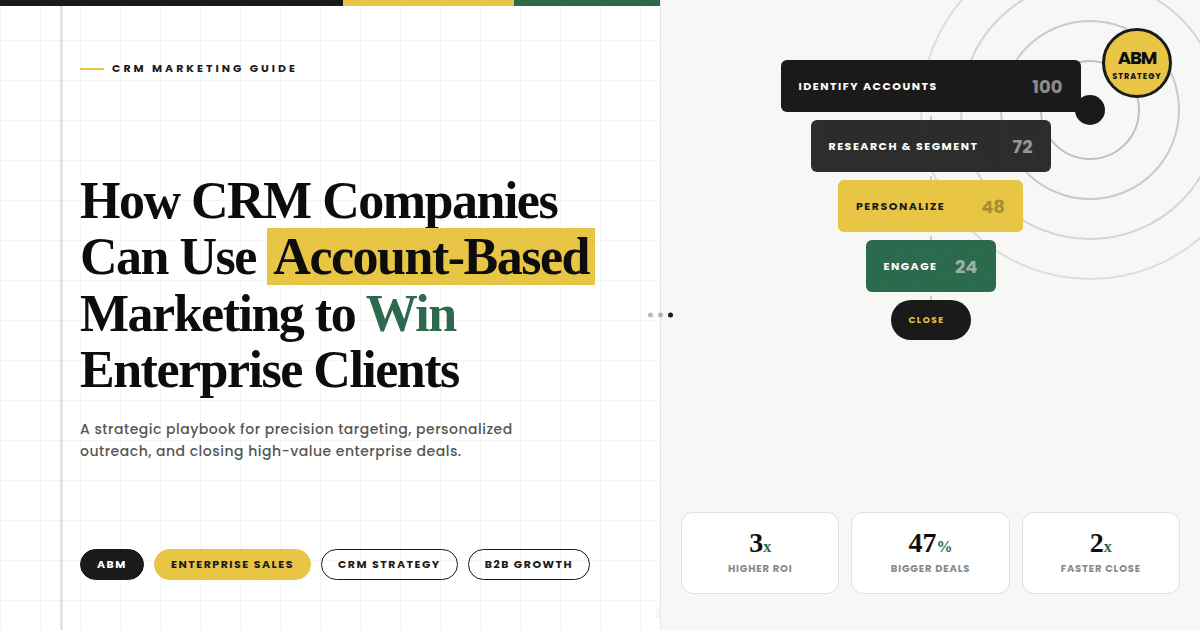
Winning enterprise clients is not just about having a powerful CRM platform. It is about delivering relevance, trust, and a highly personalized experience at every touchpoint. Traditional lead generation often falls short when targeting large organizations. This is where Account-Based Marketing becomes a game changer.
Account-Based Marketing or ABM allows CRM companies to focus their efforts on high-value accounts with tailored strategies that resonate with decision-makers. Instead of casting a wide net, ABM focuses on precision and impact.
Why Enterprise Clients Require a Different Approach
Enterprise buyers are not impulsive. They involve multiple stakeholders, long sales cycles, and complex decision-making processes. A generic marketing campaign rarely addresses their specific needs.
CRM companies targeting enterprises must:
- Understand industry-specific challenges
- Align messaging with business goals
- Build relationships across departments
ABM makes this possible by shifting the focus from leads to accounts.
What is Account-Based Marketing in CRM Context
Account-Based Marketing is a strategic approach where marketing and sales teams collaborate to target specific high-value accounts with personalized campaigns.
For CRM companies, this means:
- Identifying enterprises that would benefit most from their solution
- Creating tailored messaging for each account
- Engaging multiple stakeholders within the same organization
The goal is to make every interaction feel relevant and valuable.
Step 1: Identify High-Value Enterprise Accounts
The foundation of ABM lies in selecting the right accounts. CRM companies should use data-driven insights to identify organizations that align with their ideal customer profile.
Key factors to consider:
- Company size and revenue
- Industry and use case fit
- Existing tech stack
- Growth potential
Focusing on quality over quantity ensures better conversion rates.
Step 2: Deep Research and Account Insights
Once target accounts are identified, the next step is understanding them deeply.
CRM companies should analyze:
- Business challenges and pain points
- Current CRM limitations
- Competitor usage
- Decision-making hierarchy
This level of insight helps craft messaging that speaks directly to the client’s needs.
Step 3: Personalize Messaging and Content
Generic messaging does not work with enterprise clients. Personalization is the core of ABM.
Examples of personalized content include:
- Custom case studies for similar industries
- Tailored email campaigns addressing specific pain points
- Personalized landing pages
- Executive-level presentations
The more relevant the message, the higher the engagement.
Step 4: Align Sales and Marketing Teams
ABM cannot succeed without strong collaboration between sales and marketing.
CRM companies should:
- Share account insights across teams
- Develop unified messaging
- Coordinate outreach strategies
This alignment ensures a consistent and seamless experience for the client.
Step 5: Engage Across Multiple Channels
Enterprise clients interact with brands across multiple platforms. A successful ABM strategy uses a mix of channels to stay visible and relevant.
Effective channels include:
- LinkedIn outreach
- Email campaigns
- Webinars and events
- Personalized ads
Consistency across channels builds trust and keeps the brand top of mind.
Step 6: Demonstrate Value Through Proof
Enterprise clients rely heavily on proof before making decisions. CRM companies must showcase tangible results.
This can be done through:
- Case studies with measurable outcomes
- Testimonials from similar enterprises
- ROI projections
- Product demonstrations
Showing real impact reduces hesitation and builds confidence.
Step 7: Measure and Optimize Campaigns
ABM is not a one-time effort. Continuous optimization is key.
CRM companies should track:
- Engagement levels within target accounts
- Pipeline growth
- Conversion rates
- Deal size and revenue impact
Analyzing these metrics helps refine strategies and improve results over time.
Benefits of ABM for CRM Companies
Implementing ABM offers several advantages:
- Higher conversion rates
- Shorter sales cycles
- Stronger client relationships
- Increased deal sizes
Most importantly, it positions CRM companies as strategic partners rather than just vendors.
Final Thoughts
Account-Based Marketing is not just a marketing tactic. It is a strategic shift that enables CRM companies to connect with enterprise clients on a deeper level.
By focusing on personalization, alignment, and value-driven engagement, CRM companies can build trust and win high-value deals. In a competitive market, ABM provides the edge needed to stand out and succeed.

Leave a Reply