
Most teams trust their CRM because it feels like the source of truth.
Every lead is logged.
Every deal has a stage.
Every activity has a timestamp.
It looks organised.
But pipeline does not become predictable just because the CRM is clean.
That is the mistake many B2B teams make.
CRM data tells you what has already entered your system.
Intent data helps you understand what may be forming before it becomes visible.
The real question is not which data source is better.
The real question is which one helps you act before the buyer has already made up their mind.
CRM Data Shows What Happened
CRM data is useful.
It tells you who filled a form, who attended a demo, who opened a sales conversation and where an opportunity currently sits.
That matters.
Sales teams need structure. Marketing teams need reporting. Leadership needs visibility.
But CRM data has a limitation.
It is mostly reactive.
By the time an account appears in your CRM, the buyer has already done some level of research. They may have compared vendors, discussed pain points internally or shortlisted possible solutions.
So CRM gives you visibility.
But not always early visibility.
And in modern B2B buying, early visibility is where the advantage is.
Intent Data Shows What Is Building
Intent data looks outside your owned funnel.
It helps identify which accounts are researching topics related to your solution, what problems they are exploring and when interest starts to increase.
That makes it powerful.
But only if it is understood properly.
Intent data does not mean the buyer is ready to speak to sales.
It means there is movement.
That movement could be early research. It could be internal education. It could be vendor comparison. It could also be a real buying window.
The value is not in the signal alone.
The value is in interpreting the signal correctly.
The Problem With CRM Only Thinking
CRM data often creates a false sense of control.
A deal is in the pipeline, so teams assume it is active.
A lead has a score, so teams assume it is qualified.
A contact responded, so teams assume the account is interested.
But one contact does not equal account readiness.
One demo does not equal buying intent.
One deal stage does not equal momentum.
This is where CRM data can mislead teams.
It captures activity after the buyer has surfaced.
It does not always explain what is happening around the account, inside the buying group or before the first conversation.
The Problem With Intent Only Thinking
Intent data also gets misused.
Some teams treat every intent spike as a sales trigger.
An account shows interest in a topic.
Sales reaches out immediately.
The buyer is still researching.
The conversation feels too early.
And the opportunity disappears before it had a chance to develop.
That is not an intent data problem.
That is an activation problem.
Intent data should not automatically create sales pressure.
It should guide timing, messaging and prioritisation.
What Actually Predicts Pipeline
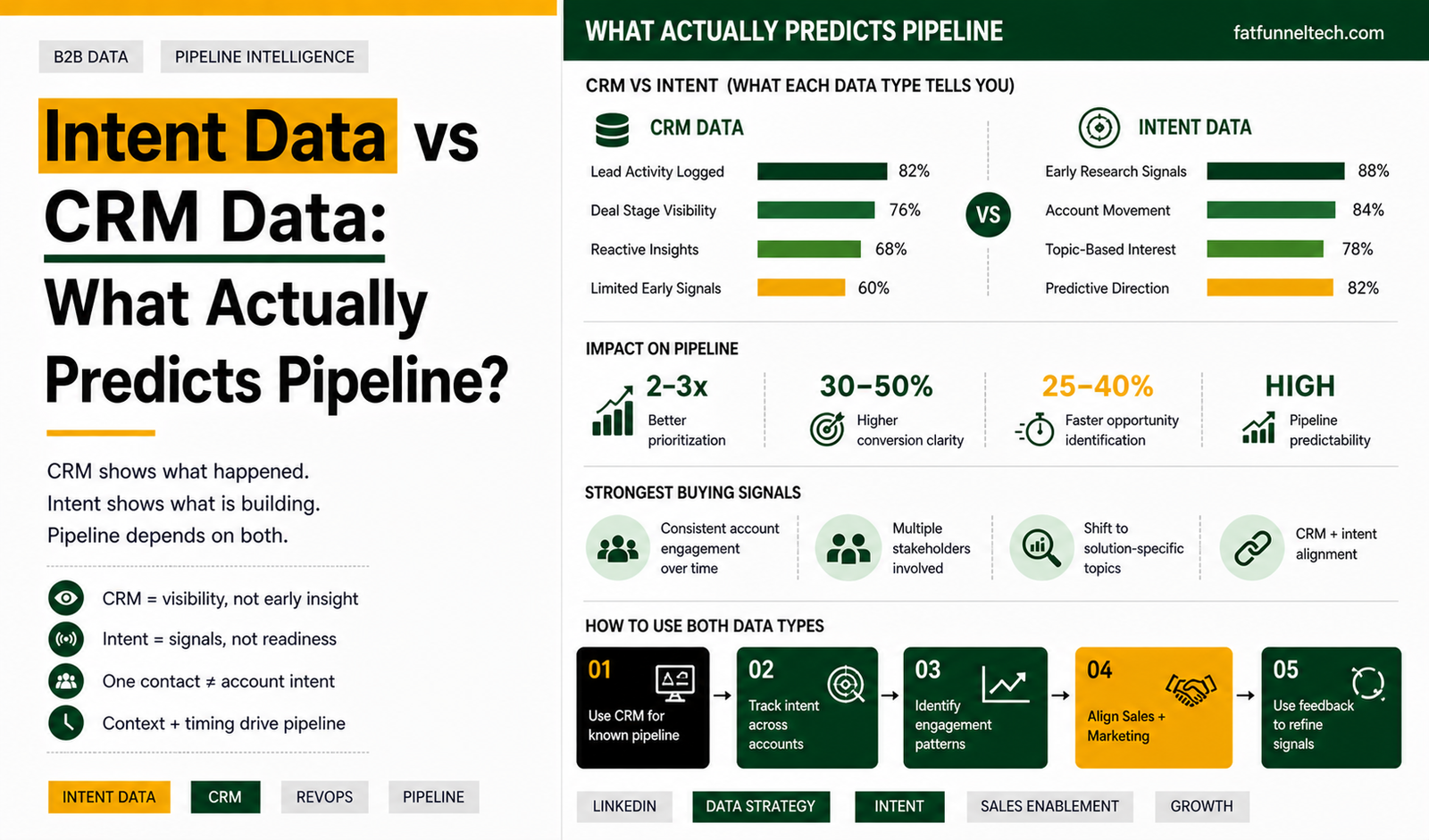
Pipeline is not predicted by CRM data alone.
It is not predicted by intent data alone either.
Pipeline becomes more predictable when both are connected with context.
The strongest signals usually appear when:
- Account interest is increasing over time
A single activity means very little.
A pattern means more.
If an account keeps researching the same problem, engages across multiple touchpoints and moves from broad topics to solution-specific content, that is a stronger signal.
- Multiple stakeholders are involved
Pipeline is rarely built around one person.
If only one contact is active, it may be research.
If multiple people from the same company are engaging, the account may be moving internally.
This is where buying group visibility matters.
- CRM activity matches external intent
The best signals happen when CRM data and intent data support each other.
For example, an account is showing external research activity and someone from that account has also engaged with your content or spoken to sales.
That combination is stronger than either signal alone.
- The topic shows buying stage progression
Not all topics mean the same thing.
A buyer reading general education content is not the same as a buyer researching implementation, migration, pricing or vendor comparison.
The topic matters because it shows where the buyer may be in the journey.
- Sales feedback confirms readiness
Data can suggest movement.
Sales conversations confirm reality.
If sales hears urgency, budget pressure, internal change or stakeholder involvement, that insight should feed back into the scoring model.
Without sales feedback, data stays incomplete.
A Real Example
Imagine two accounts.
Account A fills out a demo form.
Your CRM marks it as a high priority lead.
But intent data shows no previous research, no wider account activity and no related topic engagement.
This may be curiosity.
Now look at Account B.
No form fill yet.
But three stakeholders from the same company are researching CRM migration, sales productivity and pipeline visibility. One person has visited your comparison page. Another has engaged with a webinar.
This account may be more valuable than the lead sitting in your CRM.
That is the difference.
CRM shows what is visible.
Intent data helps reveal what is forming.
Why This Matters for Sales and Marketing Alignment
Sales trusts CRM because that is where deals live.
Marketing trusts intent because that is where early demand appears.
Both are right.
Both are incomplete.
Marketing should not throw intent signals over the wall and call them qualified.
Sales should not ignore intent because it is not yet in the CRM.
The better approach is shared interpretation.
Marketing identifies account movement.
Sales validates readiness.
RevOps connects both into scoring, prioritisation and reporting.
That is how data becomes useful.
The Better Way to Use Both
Use CRM data to understand known pipeline.
Use intent data to identify emerging demand.
Use account-level engagement to see buying group movement.
Use sales feedback to validate whether the signal is real.
Use content behaviour to understand buyer stage.
This is what turns data into demand intelligence.
Not more dashboards.
Not more lead scores.
Better interpretation.
Final Thought
CRM data tells you where the buyer has already shown up.
Intent data tells you where the buyer may be moving before they raise their hand.
One gives structure.
The other gives early visibility.
But neither predicts pipeline on its own.
Pipeline becomes predictable when teams connect signals, understand buying groups and act with timing.
Because the future of pipeline is not about having more data.
It is about knowing which signals actually mean revenue is coming.
Leave a Reply