

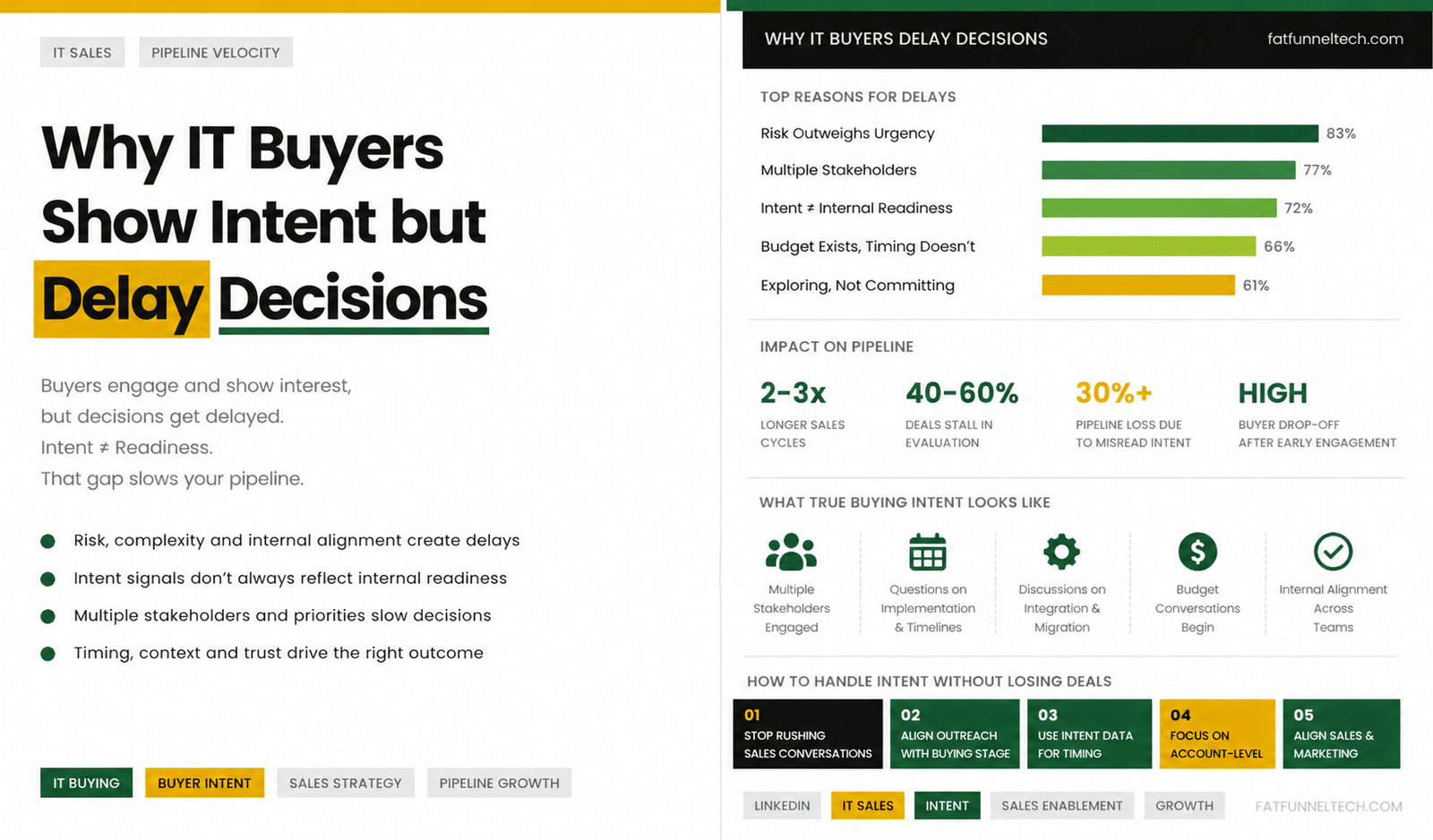
If you sell to IT teams, this pattern is hard to miss.
Buyers engage.
They research.
They attend demos.
They ask detailed questions.
Everything signals interest.
But then?
Silence.
Decisions get delayed. Deals stall. Pipeline slows down.
It feels like momentum was there, but something stopped it.
The reality is simple.
Intent does not always mean readiness.
And in IT buying, that gap is wider than most teams expect.
The Nature of IT Buying
IT decisions are rarely isolated.
They affect:
- Systems
- Security
- Integrations
- Business operations
That makes every decision heavier.
Even when buyers show intent, they are thinking about:
- Risk
- Compatibility
- Long-term impact
So while engagement may look strong, hesitation is built into the process.
Why IT Buyers Delay Even When Interested
1. Risk outweighs urgency
In IT, making the wrong decision is worse than making no decision.
Buyers ask:
- Will this break existing systems?
- Will implementation disrupt operations?
- What if this fails?
Even if your solution is strong, perceived risk slows things down.
2. Multiple stakeholders slow everything
IT purchases involve:
- IT teams
- Security teams
- Finance
- Leadership
Each group has different priorities.
Even if one stakeholder is ready, others may not be.
Alignment takes time.
And until it happens, decisions pause.
3. Intent signals don’t reflect internal readiness
Intent data may show:
- Research activity
- Content engagement
- Vendor comparisons
But it doesn’t show:
- Internal approvals
- Budget alignment
- Strategic priority
So while buyers look active externally, they may still be early internally.
4. Budget exists, but timing doesn’t
A company might have budget.
But that doesn’t mean it’s allocated now.
IT budgets are often tied to:
- Planning cycles
- Project timelines
- Business priorities
If your solution is not aligned with current priorities, it gets delayed.
5. Buyers are exploring, not committing
Not every engaged buyer is ready to decide.
Many are:
- Building a shortlist
- Understanding the market
- Preparing for future investment
From your side, it looks like momentum.
From their side, it’s preparation.
The Intent Data Misinterpretation
This is where most teams go wrong.
They see intent signals and assume:
“This account is ready to buy.”
So sales engages aggressively.
Buyers feel pressured.
And instead of accelerating, they step back.
Intent was real.
But timing was misread.
The Gap Between Interest and Decision
In IT sales, there are stages:
- Awareness
- Exploration
- Evaluation
- Decision
Most intent signals come from:
- Awareness and exploration
But sales often treats them as evaluation or decision stage.
That mismatch creates friction.
What High-Intent Actually Looks Like in IT
True buying intent shows deeper signals:
- Multiple stakeholders involved in conversations
- Questions about implementation and timelines
- Discussions around integration and migration
- Budget-related conversations
These signals are fewer.
But far more reliable.
How to Handle Intent Without Losing Deals
1. Stop rushing the sales conversation
Not every engaged account needs immediate sales pressure.
Early-stage buyers need:
- Insights
- Education
- Context
Rushing them reduces trust.
2. Align outreach with buying stage
Match your approach to where the buyer is:
- Early stage → share perspectives
- Mid stage → discuss problems
- Late stage → drive decisions
This improves engagement quality.
3. Use intent data for timing, not just targeting
Intent data tells you when interest starts.
Not when decisions happen.
Track how intent evolves over time.
That’s where real timing appears.
4. Focus on account-level engagement
One person showing intent is not enough.
Look for:
- Multiple stakeholders engaging
- Cross-team activity
That indicates stronger buying movement.
5. Build alignment between sales and marketing
Marketing sees signals.
Sales builds conversations.
If both teams are not aligned on:
- What intent means
- When to engage
Opportunities get lost.
The Real Issue
IT buyers don’t delay because they lack interest.
They delay because decisions are complex.
When teams treat early intent as buying readiness, they create pressure.
And pressure slows decisions even further.
Final Thought
Intent data gives you visibility.
But visibility is not clarity.
In IT sales, the difference between interest and decision is defined by timing, alignment and risk.
The goal is not to chase every signal.
It’s to understand which signals matter.
Because the teams that win are not the ones that engage first.
They are the ones that engage at the right moment.
Leave a Reply