

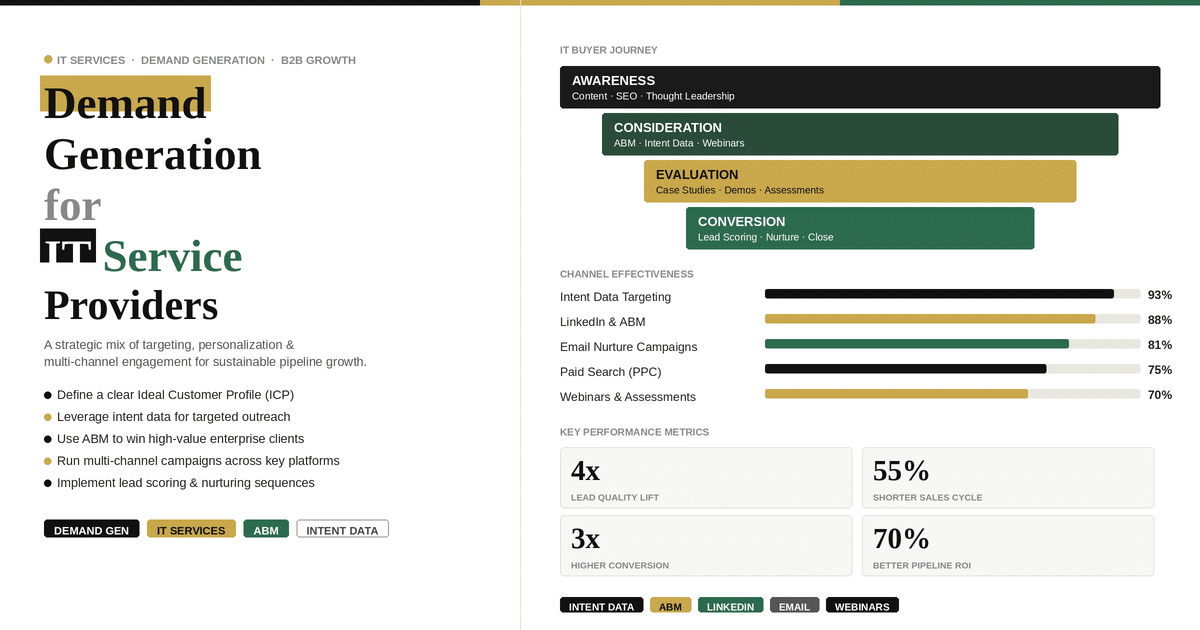
In today’s highly competitive technology landscape, IT service providers are under constant pressure to generate consistent, high-quality demand while differentiating their offerings. With services ranging from cloud and cybersecurity to managed IT and consulting, the challenge is not just visibility but attracting the right clients who are ready to engage.
For B2B IT service providers, demand generation requires a strategic mix of targeting, personalization, and multi-channel engagement to build a strong and sustainable pipeline.
Understanding the IT Services Buyer Journey
IT service decisions are complex and often involve multiple stakeholders such as IT leaders, procurement teams, and business executives.
Key characteristics of buyers:
- Long evaluation and decision cycles
- Strong focus on ROI and business impact
- Need for scalability and security
- Preference for trusted and proven providers
Understanding this journey helps create more effective demand generation strategies.
Define a Clear Ideal Customer Profile
High-quality demand starts with targeting the right audience. IT service providers should define their Ideal Customer Profile based on:
- Industry and business size
- IT infrastructure maturity
- Specific service needs such as cloud, security, or support
- Growth stage and digital transformation goals
A well-defined ICP ensures marketing efforts are focused on high-potential accounts.
Leverage Intent Data for Targeted Outreach
Intent data enables IT service providers to identify companies actively researching solutions.
Key signals include:
- Searches related to IT outsourcing or managed services
- Engagement with cloud or cybersecurity content
- Research on digital transformation initiatives
Targeting high-intent accounts improves lead quality and conversion rates.
Use Account-Based Marketing for Enterprise Clients
For high-value enterprise deals, Account-Based Marketing is highly effective.
Strategies include:
- Targeting specific organizations with personalized campaigns
- Engaging multiple stakeholders within accounts
- Delivering tailored messaging and solutions
ABM increases engagement and helps close larger deals.
Create Value-Driven Content
Content marketing plays a critical role in attracting and nurturing prospects.
Effective content formats include:
- Case studies showcasing business outcomes
- Whitepapers on IT trends and challenges
- Blogs addressing industry-specific pain points
- Webinars demonstrating expertise
Content should focus on solving real business problems.
Optimize Website for Lead Conversion
Your website is a key demand generation asset. It should be designed to convert visitors into qualified leads.
Important elements include:
- Clear value proposition
- Industry-specific landing pages
- Strong calls to action
- Easy-to-complete forms
Adding tools like ROI calculators can further increase engagement.
Run Multi-Channel Marketing Campaigns
IT buyers interact across multiple channels before making decisions. A multi-channel strategy ensures consistent engagement.
Effective channels include:
- LinkedIn for B2B outreach
- Email campaigns for nurturing leads
- Paid search for high-intent keywords
- Webinars focused on IT challenges
Consistency across channels builds trust and awareness.
Offer Consultations and Service Assessments
IT services often require detailed evaluation. Offering free consultations or assessments can improve lead quality.
Benefits include:
- Demonstrating expertise
- Identifying client-specific needs
- Building trust early in the process
This approach helps attract serious prospects.
Align Sales and Marketing Teams
Demand generation is most effective when sales and marketing teams work together.
Best practices include:
- Sharing account insights and data
- Coordinating outreach strategies
- Maintaining consistent messaging
Alignment ensures a seamless buyer experience.
Implement Lead Scoring and Nurturing
Not all leads are ready to convert immediately. Lead scoring helps prioritize prospects based on engagement and intent.
Nurturing strategies include:
- Email drip campaigns
- Personalized follow-ups
- Educational content sequences
This keeps prospects engaged until they are ready to buy.
Measure and Optimize Performance
Continuous optimization is essential for successful demand generation.
Key metrics to track:
- Cost per lead
- Conversion rates
- Pipeline contribution
- Customer acquisition cost
Data-driven insights help refine strategies and improve ROI.
Final Thoughts
Demand generation for IT service providers requires a strategic approach that combines targeting, personalization, and consistent engagement. By leveraging intent data, ABM, and value-driven content, companies can attract high-quality leads and build a strong pipeline.
In a competitive IT services market, the ability to generate and convert demand effectively can be the key to long-term growth and success.
Leave a Reply