

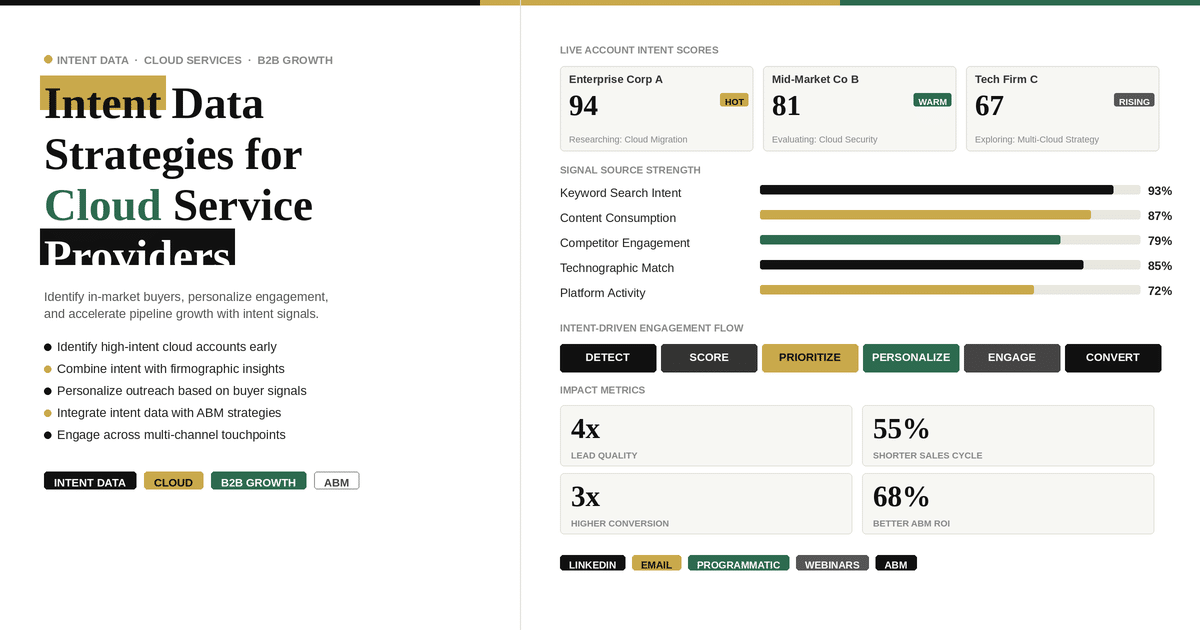
In a highly competitive cloud ecosystem, service providers are constantly seeking smarter ways to identify, engage, and convert high-value prospects. With long sales cycles and complex decision-making processes, traditional lead generation often lacks precision and timing.
Intent data is emerging as a powerful strategy that enables cloud service providers to identify in-market buyers, personalize engagement, and accelerate pipeline growth. For B2B cloud companies, leveraging intent signals can significantly improve lead quality and conversion rates.
Understanding the Role of Intent Data in Cloud
Intent data refers to behavioral signals that indicate a company’s interest in specific solutions. These signals are gathered from online activities such as content consumption, keyword searches, and engagement with industry platforms.
For cloud service providers, intent data can reveal:
- Companies exploring cloud migration
- Businesses evaluating cloud security solutions
- Organizations researching multi-cloud strategies
This insight helps identify prospects who are actively in the buying journey.
Identify High-Intent Cloud Accounts
The first step in an intent-driven strategy is identifying accounts that show strong buying signals.
Key indicators include:
- Increased searches related to cloud services
- Engagement with competitor platforms
- Consumption of technical content such as whitepapers
Focusing on high-intent accounts ensures better targeting and improved conversion potential.
Combine Intent Data with Firmographic Insights
Intent data becomes more powerful when combined with firmographic and technographic data.
Cloud providers should analyze:
- Company size and industry
- Existing cloud infrastructure
- Growth stage and digital maturity
- Technology stack and integration needs
This combination helps prioritize accounts that are both interested and a strong fit.
Align Sales and Marketing Teams
Intent data creates a unified view of the buyer journey, enabling better alignment between sales and marketing.
Best practices include:
- Sharing real-time intent signals across teams
- Prioritizing outreach based on intent scores
- Coordinating messaging and campaigns
Alignment ensures timely and consistent engagement.
Personalize Engagement Based on Buyer Intent
Generic outreach is ineffective in the cloud space. Intent data allows providers to tailor messaging based on what prospects are actively researching.
Examples:
- Highlighting migration strategies for companies exploring cloud adoption
- Offering security solutions to businesses focused on compliance
- Demonstrating cost optimization for finance-driven stakeholders
Personalized engagement increases relevance and builds trust.
Integrate Intent Data with ABM Strategies
Intent data works best when combined with Account-Based Marketing.
Cloud service providers can:
- Identify high-value accounts earlier
- Prioritize accounts with active interest
- Deliver targeted and personalized campaigns
This integration improves campaign efficiency and ROI.
Leverage Multi-Channel Engagement
Once high-intent accounts are identified, engaging them across multiple channels is essential.
Effective channels include:
- LinkedIn outreach targeting decision-makers
- Email campaigns aligned with intent signals
- Programmatic advertising for account visibility
- Webinars focused on cloud challenges
A multi-channel approach ensures continuous engagement.
Use Intent Data for Better Timing
Timing is critical in cloud sales. Intent data helps providers engage prospects when they are actively researching solutions.
Benefits include:
- Early identification of buying signals
- Faster engagement with prospects
- Reduced sales cycle duration
Engaging at the right time increases conversion rates.
Showcase Value with Data and Proof
Cloud investments require strong justification. Providers must demonstrate clear business impact.
This can be achieved through:
- Case studies with measurable outcomes
- ROI calculators for cost savings
- Industry-specific success stories
- Technical demonstrations
Proof-driven engagement builds credibility and accelerates decision-making.
Measure and Optimize Intent-Driven Campaigns
Continuous tracking is essential to maximize the effectiveness of intent strategies.
Key metrics include:
- Engagement levels from target accounts
- Conversion rates of high-intent leads
- Pipeline contribution
- Revenue impact
Data-driven insights help refine targeting and improve outcomes.
Overcome Challenges in Intent Data Usage
While intent data offers significant advantages, cloud service providers may face challenges such as data accuracy and integration.
To address these:
- Use reliable intent data sources
- Combine multiple data providers
- Integrate intent data with CRM and marketing automation tools
A structured approach ensures better scalability and results.
Final Thoughts
Intent data is transforming how cloud service providers approach B2B growth. By identifying in-market buyers and delivering personalized engagement, companies can improve lead quality, shorten sales cycles, and drive sustainable revenue.
In a fast-evolving cloud market, the ability to act on real-time buyer intent can be the key differentiator for long-term success.
Leave a Reply