

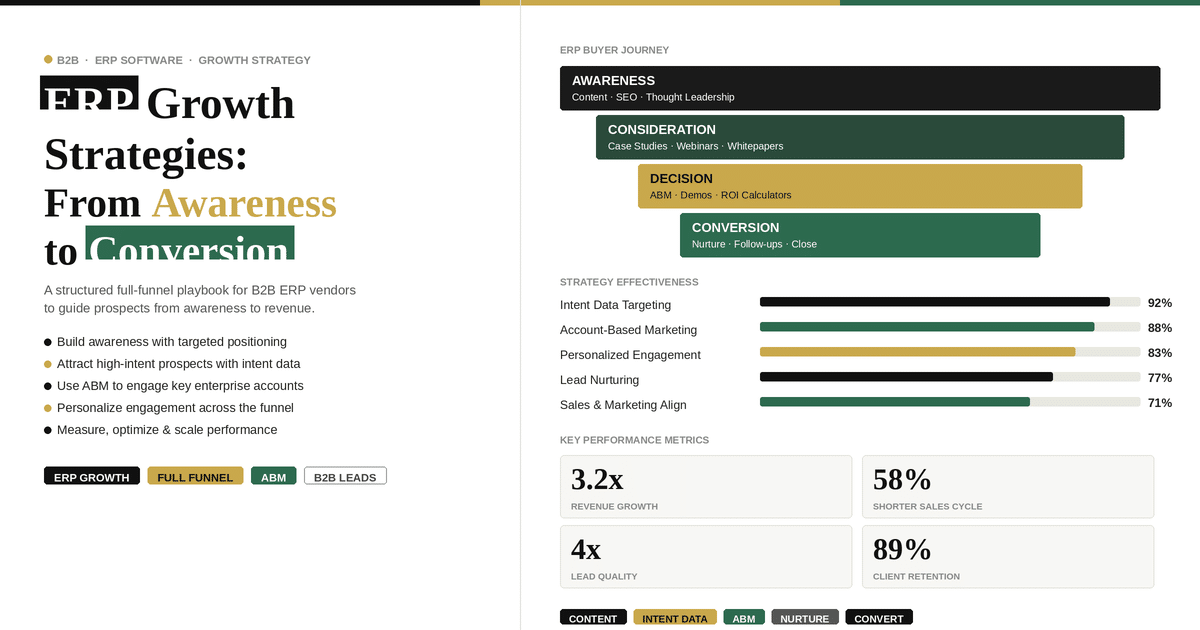
In today’s competitive enterprise software landscape, ERP vendors must go beyond traditional marketing to drive consistent growth. With long sales cycles, complex buying processes, and multiple stakeholders involved, success depends on guiding prospects seamlessly from initial awareness to final conversion.
For B2B ERP providers, growth is not a single tactic. It is a structured journey that combines targeted outreach, value-driven engagement, and data-backed optimization at every stage of the funnel.
Understanding the ERP Growth Funnel
The ERP buyer journey is typically divided into key stages:
- Awareness
- Consideration
- Decision
- Conversion
Each stage requires a tailored strategy to move prospects closer to purchase while addressing their specific concerns and needs.
Building Awareness with Targeted Positioning
The first step in ERP growth is creating strong market awareness among the right audience.
ERP vendors should focus on:
- Industry-specific messaging
- Highlighting business challenges such as inefficiencies or lack of visibility
- Educating prospects about the benefits of ERP adoption
Content marketing, SEO, and thought leadership play a crucial role in attracting early-stage buyers.
Attract High-Intent Prospects with Intent Data
Not all awareness leads are valuable. ERP companies must identify prospects who are actively researching solutions.
Intent data helps:
- Detect companies exploring ERP implementation or upgrades
- Prioritize accounts showing buying signals
- Improve targeting precision
Focusing on high-intent prospects ensures better pipeline quality.
Engage with Value-Driven Content
Once prospects enter the consideration stage, they need deeper insights to evaluate solutions.
Effective content includes:
- Case studies demonstrating ROI and efficiency gains
- Whitepapers addressing industry-specific challenges
- Product comparison guides
- Webinars showcasing use cases
This stage is about building trust and positioning your solution as the best fit.
Use Account-Based Marketing for Key Accounts
ERP deals are often high-value and require personalized engagement. Account-Based Marketing is highly effective in targeting enterprise clients.
Strategies include:
- Identifying high-value accounts
- Creating account-specific campaigns
- Engaging multiple stakeholders within organizations
ABM ensures more relevant communication and higher conversion potential.
Optimize the Sales Funnel for Conversion
A well-structured funnel is essential to convert prospects into customers.
Key elements include:
- Dedicated landing pages with clear value propositions
- Strong calls to action
- Simplified lead capture forms
- Timely follow-ups from sales teams
Reducing friction at this stage increases conversion rates.
Personalize Engagement Across the Journey
ERP buyers expect solutions tailored to their specific needs. Personalization is critical across all stages.
Examples:
- Industry-focused messaging for manufacturing or retail
- Role-based content for CFOs, CIOs, or operations heads
- Customized demos addressing specific business challenges
Personalized engagement builds trust and accelerates decision-making.
Align Sales and Marketing Teams
Growth from awareness to conversion requires strong collaboration between sales and marketing.
Best practices:
- Shared account insights and data
- Coordinated outreach strategies
- Consistent messaging across touchpoints
Alignment ensures a seamless experience for prospects.
Showcase ROI and Business Impact
ERP investments require strong justification. Vendors must clearly demonstrate value.
This can be done through:
- ROI calculators
- Case studies with measurable outcomes
- Industry-specific success stories
- Proof of scalability and integration
Proof-driven engagement reduces hesitation and builds confidence.
Nurture Leads Through the Funnel
Not all prospects convert immediately. A strong nurturing strategy keeps them engaged.
Effective tactics include:
- Email drip campaigns
- Educational content sequences
- Personalized follow-ups
Nurturing ensures prospects move steadily toward conversion.
Measure and Optimize Performance
Continuous optimization is essential for sustainable growth.
Key metrics to track:
- Conversion rates at each stage
- Cost per lead
- Pipeline contribution
- Customer acquisition cost
Data-driven insights help refine strategies and improve ROI.
Final Thoughts
ERP growth is not just about generating leads. It is about guiding prospects through a structured journey from awareness to conversion. By combining intent data, personalized engagement, and aligned sales and marketing efforts, ERP vendors can build a strong pipeline and drive consistent revenue growth.
In a competitive enterprise software market, companies that master the full funnel will be best positioned to scale and succeed.
Leave a Reply