

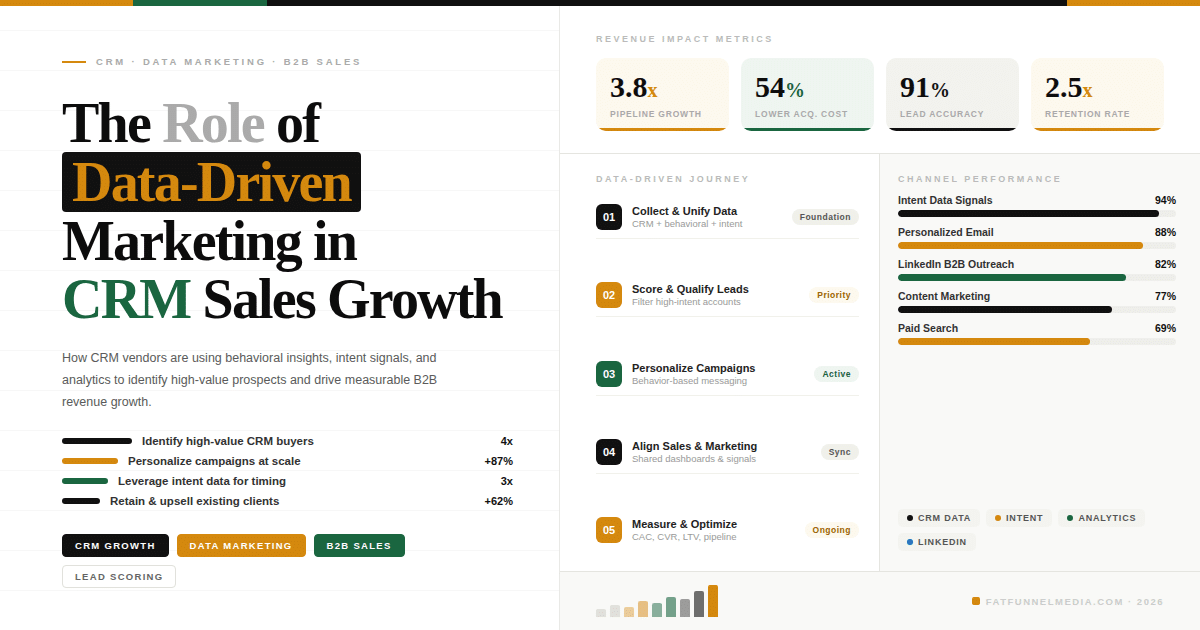
In an increasingly competitive CRM landscape, vendors are under pressure to not only generate leads but also drive measurable sales growth. With buyers becoming more informed and sales cycles growing more complex, traditional marketing approaches are no longer sufficient.
Data-driven marketing is enabling CRM companies to make smarter decisions, target the right prospects, and optimize every stage of the sales journey. For B2B CRM providers, it has become a critical driver of sustainable revenue growth.
The Shift Toward Data-Driven CRM Marketing
CRM solutions are designed to manage customer relationships and sales pipelines, yet many vendors still rely on guesswork in their own marketing strategies.
Today, the shift toward data-driven marketing allows CRM companies to:
- Identify high-value prospects
- Understand buyer behavior
- Optimize campaigns in real time
- Align marketing with sales outcomes
This shift ensures that marketing efforts are directly tied to revenue impact.
What is Data-Driven Marketing in CRM
Data-driven marketing involves using customer data, behavioral insights, and analytics to guide marketing strategies and decisions.
For CRM vendors, this includes:
- Tracking user interactions across channels
- Analyzing engagement with content and campaigns
- Leveraging CRM data to refine targeting
The goal is to create more relevant and effective marketing initiatives.
Identify High-Value CRM Buyers
One of the biggest advantages of data-driven marketing is the ability to identify high-value prospects.
CRM companies can use data to analyze:
- Company size and industry fit
- Technology stack and integration needs
- Engagement patterns and intent signals
This helps prioritize accounts that are more likely to convert.
Personalize Marketing Campaigns at Scale
Personalization is a key driver of B2B success. Data-driven insights enable CRM vendors to tailor messaging based on buyer behavior and preferences.
Examples include:
- Sending targeted emails based on user activity
- Delivering personalized content recommendations
- Creating account-specific campaigns
Personalization increases engagement and improves conversion rates.
Improve Lead Quality and Conversion Rates
Data-driven marketing helps filter out low-quality leads and focus on prospects with higher intent.
Key benefits include:
- Better lead scoring and qualification
- Reduced acquisition costs
- Higher conversion rates
By focusing on quality over quantity, CRM vendors can build a stronger pipeline.
Align Sales and Marketing Teams
Data serves as a common foundation for both sales and marketing teams.
CRM companies can:
- Share real-time insights on lead behavior
- Track account engagement across touchpoints
- Coordinate outreach strategies
This alignment ensures a seamless and consistent buyer experience.
Optimize Multi-Channel Campaigns
Modern buyers interact across multiple channels before making decisions. Data-driven marketing helps identify which channels deliver the best results.
Effective channels include:
- LinkedIn for B2B engagement
- Email campaigns for nurturing
- Paid search for high-intent queries
- Content marketing for education
Data helps allocate resources to the most effective channels.
Use Analytics to Refine Strategies
Continuous improvement is essential for growth. CRM vendors must track and analyze performance metrics to refine their strategies.
Key metrics include:
- Conversion rates
- Cost per lead
- Pipeline contribution
- Customer acquisition cost
Insights from analytics help optimize campaigns and improve ROI.
Leverage Intent Data for Better Timing
Intent data enhances data-driven marketing by identifying prospects actively researching CRM solutions.
Benefits include:
- Engaging prospects at the right time
- Prioritizing high-intent accounts
- Increasing conversion probability
Combining intent data with CRM insights creates a powerful growth engine.
Enhance Customer Retention and Upselling
Data-driven marketing is not limited to acquisition. It also plays a crucial role in retention and expansion.
CRM companies can:
- Analyze customer usage patterns
- Identify upsell and cross-sell opportunities
- Deliver personalized engagement
This approach drives long-term revenue growth.
Overcome Challenges in Data Utilization
While data-driven marketing offers significant advantages, it requires proper implementation.
CRM vendors should:
- Ensure data accuracy and consistency
- Integrate multiple data sources
- Use advanced analytics tools
A structured approach ensures maximum value from data insights.
Final Thoughts
Data-driven marketing is transforming how CRM companies approach sales growth. By leveraging insights, personalization, and analytics, vendors can attract high-value prospects, improve conversion rates, and build stronger customer relationships.
In a competitive CRM market, the ability to make informed decisions based on data can be the key differentiator that drives long-term success.
Leave a Reply