

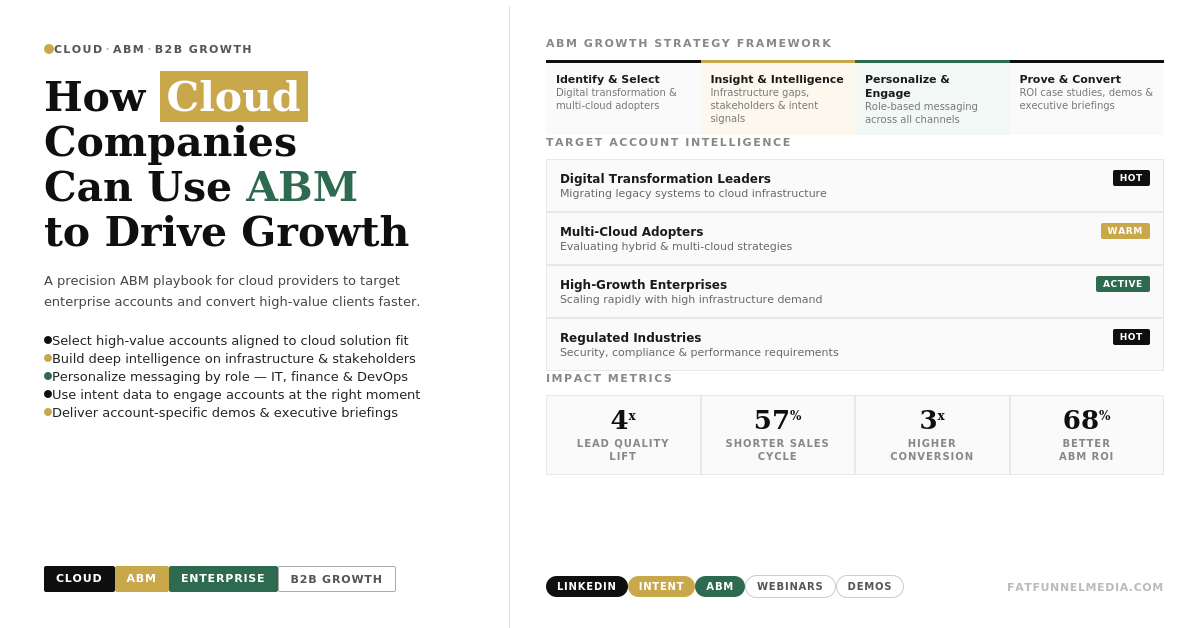
In an increasingly competitive cloud ecosystem, companies are no longer competing solely on infrastructure, pricing, or features. The real differentiator lies in how effectively they engage high-value prospects and convert them into long-term clients.
Account-Based Marketing has emerged as a powerful growth strategy for cloud companies looking to target enterprise clients with precision. By focusing on specific accounts rather than broad audiences, ABM enables cloud providers to drive higher engagement, faster conversions, and stronger client relationships.
Why ABM is Critical for Cloud Companies
Cloud solutions often involve complex implementations, high investment, and multiple stakeholders. Buyers typically include IT leaders, DevOps teams, finance heads, and C-level executives.
Key challenges in cloud sales:
- Long sales cycles
- Multiple decision-makers
- High competition
- Need for strong ROI justification
ABM addresses these challenges by delivering personalized and targeted engagement.
Identify High-Value Target Accounts
The first step in any ABM strategy is selecting the right accounts. Cloud companies should focus on organizations that align with their solution offerings.
Key criteria include:
- Companies undergoing digital transformation
- Businesses adopting multi-cloud or hybrid cloud strategies
- Organizations with high infrastructure demands
- Enterprises scaling rapidly
Targeting the right accounts ensures better conversion outcomes.
Build Deep Account Intelligence
Successful ABM campaigns rely on a deep understanding of each target account.
Cloud companies should analyze:
- Existing cloud infrastructure and providers
- Business challenges related to scalability or cost
- Security and compliance requirements
- Key stakeholders and decision-makers
These insights enable more relevant and impactful engagement.
Personalize Messaging for Cloud Use Cases
Generic messaging is ineffective in the cloud space. Buyers expect solutions tailored to their specific needs.
Examples of personalized messaging:
- Cost optimization strategies for finance teams
- Scalability solutions for growing businesses
- Security and compliance for regulated industries
- Performance improvements for high-demand applications
Personalized communication increases engagement and builds trust.
Leverage Multi-Channel ABM Campaigns
Cloud buyers interact across multiple channels before making decisions. A strong ABM strategy ensures consistent presence across touchpoints.
Effective channels include:
- LinkedIn outreach targeting IT and business leaders
- Email campaigns aligned with account-specific needs
- Targeted advertising for account visibility
- Webinars focused on cloud challenges and solutions
A coordinated multi-channel approach drives continuous engagement.
Align Sales and Marketing Teams
ABM requires strong collaboration between sales and marketing teams.
Best practices:
- Shared account insights and data
- Coordinated outreach strategies
- Regular communication and feedback
Alignment ensures a seamless and consistent experience for prospects.
Use Intent Data to Improve Targeting
Intent data helps identify accounts actively researching cloud solutions. This allows companies to engage prospects at the right time.
Key signals include:
- Searches related to cloud migration or optimization
- Engagement with cloud-related content
- Research on competitor solutions
Combining intent data with ABM improves efficiency and effectiveness.
Showcase Value with Data and Proof
Cloud investments require strong justification. Companies must clearly demonstrate the value of their solutions.
This can be achieved through:
- Case studies with measurable outcomes
- ROI calculators for cost savings
- Industry-specific success stories
- Technical demonstrations
Proof-driven engagement builds credibility and accelerates decision-making.
Create Account-Specific Experiences
Delivering personalized experiences can significantly improve engagement.
Examples include:
- Customized landing pages for target accounts
- Tailored product demos
- Exclusive executive briefings
These experiences create a premium perception and strengthen relationships.
Measure and Optimize ABM Performance
Continuous tracking is essential to improve campaign effectiveness.
Key metrics include:
- Account engagement levels
- Pipeline contribution
- Conversion rates
- Deal size and revenue impact
Data-driven insights help refine strategies and maximize ROI.
Final Thoughts
Account-Based Marketing is a powerful growth strategy for cloud companies aiming to win high-value clients. By focusing on targeted engagement, personalized messaging, and data-driven insights, cloud providers can move beyond traditional marketing and build meaningful relationships with enterprise buyers.
In a fast-evolving cloud market, ABM provides the precision and relevance needed to drive sustainable growth and long-term success.
Leave a Reply